Subscribe

RSS Feed (xml)

Powered By

Skin Design:
Free Blogger Skins

Powered by Blogger

Showing posts with label chunkster challenge. Show all posts

Tuesday, March 25, 2008

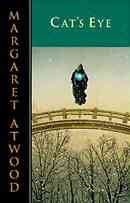
Cat's Eye

Author: Margaret Atwood
Challenge: My Year of Reading Dangerously, YA Challenge
Rating: 4/5

This is my third Atwood in as many months, and I admire her style greatly, but it is kind of like admiring a modernist painting in a museum. Yes, its sharp, well-down, but its not real cuddly and cute.

In this book, Atwood delves into the secret cruelties that girls impose on each other. Elaine Risley, a middle-aged Canadian painter is coming back to her childhood city of Toronto for the opening of a new show. While she wanders along the vaguely familiar streets, she relives her memories.

We learn at the start the outline of her life; she is divorced and remarried, she had a friend named Cordelia who was important in her life, she had a brother who liked to talk about abstract philosophical concepts. The rest of the book is about filling in the details. We learn about her childhood, first wandering like nomads with her parents and brother. She and her brother are very close as children, they do not have any other friends to play with.

Until I moved to Toronto I was happy. Before that we didn't really live anywhere; or we lived so many places it was hard to remember them. We spent a lot of the time driving, in our low-slung, boat-sized Studebaker, over back roads or along two-lane highways up north, curving past lake after lake..."

When they finally settle into a house, Elaine learns, for the first time, the perils of female friendship. She makes friends with Carol out of practicality. They both need someone to sit with at lunch. Through Carol, she meets Grace, and Cordelia.

Ruthlessly Atwood dissects the uneasy relationship between the girls. Though before Cordelia joins their group, Grace invites one or the other friend over and feels sick as soon as they start doing something she doesn't want to, Cordelia is ruthless in her cruelty.

On the window ledge beside mine, Cordelia and Grace and Carol are sitting, jammed in together, whispering and giggling. I have to sit in a window ledge by myself because they aren't speaking to me. It's something I said wrong, but I don't know what it is because they won't tell me. Cordelia says it will be better for me to think back over everything I've said today and try to pick out the wrong thing. That way I will learn not to say such a thing again. When I've guessed the right answer, then they will speak to me again. All of this is for my own good, because they are my best friends and they want to help me improve....I can't remember having said anything different from what I would ordinarily say.

This passage is the very first time Cordelia tries out her power over the other girls. She learns quickly how to manipulate and control, soon Elaine is anxious and depressed all of the time, scraping the skin off the bottom of the her feet, biting her nails until they bleed. Oh this passage sent shivers down my spine, because how well do I remember a similar incident when I was younger. In my case, there was a teacher that I ran to for help. Elaine has no one. Reflecting back, Elaine knows that her mother must have been aware of the situation, but feels that her mother must have felt unable to help her.

This book is not only about girlhood cruelty. But that does take up a large chunk of the book. Inexplicably, once they are in high school, Elaine starts walking to school with Cordelia and they fall once again into a friendship. Though they call each other best friends, Elaine has become the confident one, the one with the smart, cutting remarks.

I have a denser, more malevolent little triumph to finger: energy has passed between (Cordelia and I), and I am stronger.

Elaine finds her way to art in college and her abstract, surrealistic paintings are of objects and people from her childhood. She falls in love with two very different men, but disaster tinges both relationships. She joins a feminist group, and watches her paintings become labeled "feminist" although she isn't quite sure she fits in.

These meetings are supposed to make me feel more powerful, and in some ways they do.... But these meetings also make me nervous, and I don't understand why. I don't say much, I am awkward and uncertain, because whatever I do might be the wrong thing. I have not suffered enough, I haven't paid my dues, I have no right to speak. I feel as if I'm standing outside a closed door while decisions are being made.... At the same time I want to please.

This is a slower-paced book, rather like The Blind Assassin. It is complex, introducing us to ideas, themes, then casually dropping them only to bring them up later. You could say the book is about gender, and you'd be right. You could say the book is about the interplay between our childhood and how we turn out as adults, or that it is a character narrative, and you'd be right as well. This book is about a lot of things. That makes it a hard book to summarize, but let me emphasize that if you have the time to sink down into her prose, this is a fascinating (if somewhat chilling) look into female relationships.

Monday, January 14, 2008

The Blind Assassin (Margaret Atwood)


The first thing to know about The Blind Assassin is that it is a novel within a novel within a novel. On the first layer is a story by Iris Chase, the main character, who is reflecting back on her 80 years of life. The second layer is a novel The Blind Assassin written by her sister, Laura Chase, which involves the story of two unnamed lovers. And finally, in The Blind Assassin, there is a third layer as the two lovers tell a science fiction story in the style of the 1930’s pulp.

Certain details about the ultimate fate of characters in the book are revealed to us immediately via newspaper articles (we learn for example in the opening line that Laura kills herself), but we do not learn the full motivations and backstories until the end of the book. All three layers of the story do interact, and confusing as it sounds, they eventually start to make sense.

I found this novel hard to get into at first. When Atwood writes from Iris’ point of view, the prose is very precise in describing every single detail, and you gather the sense that the only purpose it serves is to set up the events that occur towards the end. I skipped even more so over Iris’ descriptions of what she is doing in the present time, because again they are mostly to set up her reflections of her childhood.

However, The Blind Assassin sections kept my interest, as it describes the complicated relationship between the two unnamed lovers and unraveled the story of Sakiel-Norn, a city on the brink of destruction on the far planet of Zycron.

The main narrative spends a long time describing Iris’ family and especially her relationship with her sister, Laura, in the 1930’s and 40’s. Atwood has a good grasp of the values and attitudes of that era. Iris grows up very sheltered in a fairly wealthy family and she spends a lot of time commenting on the class distinctions of the era. When her father’s factory is on the brink of closure, she agrees to a marriage of convenience to a wealthy rival industrialist on the agreement that her father’s factories will be saved. Her new husband reveals his cruelty almost immediately, though, by closing the factories anyhow, then concealing from Iris during their honeymoon that her father had passed away. During the time they are together, she is treated like an errant child, her mail and phone calls screened, her every move criticized and analyzed to ensure it doesn’t cause scandal for her husband. She is lied to constantly by her husband. Throughout this Iris remains passive, though, or so we believe.

Although I found parts of the book boring, I breezed through the last half very quickly. The book is structured almost like a mystery novel, because you begin to realize that there are certain key points that are being left out which won’t be revealed until then end, and I wanted to find out if the book was going to end how I suspected. (It did). While perhaps not her main theme, I found the gender politics of the book very intriguing. While Iris doesn’t try very hard to resist the rules, restrictions and cruelty placed on her by society and her husband, Laura stays fierce and resists in both little and big ways. Over the course of the book, however, we learn that both of their ways of coping lead to tragic results.

The more I think about this book, the more it reminds me of the other Atwood book I reviewed recently, The Handmaid’s Tale. In both novels, the female protagonist is kept powerless and gradually internalizes a feeling of helplessness. In both books, the main characters are given chances to resist and get out of their situations but simply can’t bring themselves to do anything until it is too late.

The science fiction element of the book didn't seem to enhance the plot significantly, but I think some of the best writing in the book was in the science fiction sections. For example this passage from early in the book struck me:

(Describing the supposed destruction of the city of Sakiel-Norn):

“There’s also a story that claims the city wasn’t really destroyed at all. Instead, through a charm known only to the King, the city and its inhabitants were whisked away and replaced by phantoms of themselves, and it was only these phantoms that were burnt and slaughtered. The real city was shrunk very small and placed in a cave beneath the great heap of stones…. The King knows what’s happened and it gives him nightmares, but the rest of them don’t know. They don’t know that they’ve become so small. The don’t know that they are supposed to be dead. The don’t even know they’ve been saved. To them the ceiling of rock looks like a sky: light comes in through a pinhole between the stones, and they think it’s the sun.”

I find that an interesting reflection on whether or not people really notice what goes on around them.

Is The Blind Assassin worth a read? If you are up for the challenge, read on and enjoy.

Monday, January 7, 2008

... Yet More Resolutions

The beginning of the year is a fabulous time to get interested in book challenges. There are so many starting right now that I felt like a kid in a candy store browsing around and picking which ones I wanted to join. Since I started this blog (a few short days ago) I've been dipping my toes in the pool of book challenge goodness, and now I'm taking the plunge (so to speak).

So here goes. I'm joining 7 challenges so far this year, and I hope it will actually become more!


I have already posted about the , but here's my reading list so far (almost all books mooched from the parents):

Books/Stories by Philip K. Dick
A Scanner Darkly
Our Friends From Frolix 8
Paycheck
The Minority Report
The Man in the High Castle
Flow My Tears, the Policeman Said
I Hope I Shall Arrive Soon
Radio Free Albemuth

Books by Ray Bradbury
The Toynbee Convector
Something Wicked This Way Comes
Quicker Than the Eye
The Illustrated Man

The Planet That Wasn’t by Isaac Asimov
Transition by Vonda McIntyre


Short Story Challenge
For this challenge, I have choices between 10 short stories during 2008 or 10 short story collections. I haven't finished my reading list, but this is the start:

Smoke and Mirrors by Neil Gaiman (collection)
Old Times on the Missippi by Mark Twain (story)
Do Androids Dream of Electronic Sheep? By Philip K Dick
The Overcoat by Nikolai Vasilievich Gogol

I'm planning to keep up to date on this one by participating in the discussions on A Curious Singularity


I really like this one. I get to pick 7 titles from the books which have contended for the Mythopoeic Award. I might have to add more as I get more into this one:

Little, Big by John Crowley
Seventh Son by Orson Scott Card
A Hat Full of Sky by Terry Pratchett
Anansi Boys by Neil Gaiman
Mortal Love by Elizabeth Hand
Sunshine by Robin McKinley
House of the Scorpion by Nancy Farmer


In Their Shoes Challenge
For this one, I'm reading however many books I want to that are autobiographies, memoirs, or biographies:

Eat, Pray Love Elizabeth Gilbert
A Million Little Pieces by James Frey
A Long Way Gone: Memoirs of a Boy Soldier by Ishmael Beah
Candy girl: a year in the life of an unlikely stripper by Diablo Cody.
The year of magical thinking by Joan Didion
Paula by Isabel Allende
Ten Thousand Sorrows by Elizabeth Kim


Young Adult Reading Challenge
For this one I'm reading 12 Young Adult Books. I haven't had the time to quite finish this list either, but I figure I'll browse the library as I check out new books. Now that I've finally figured out where the YA section is:

Feed by M.T. Anderson
House of the Scorpion by Nancy Farmer
The Chocolate War by Robert Cormier
The Blue Girl by Charles de Lint
Esperanza rising by Pam Mu~noz Ryan
Gathering Blue by Lois Lowry
A Great and Terrible Beauty by Libba Bray


Chunkster Challenge
For this I was a little apprehensive... 4 books in 2008 that are 450 pages or longer. But then I realized I already have a chunky book that I've started on, and another I'm planning to read for the Year of Reading Dangerously Challenge. So... easy peasy:


War and Peace
The Once and Future King by T.H. White
The Blind Assassin by Margaret Atwood
Great Expectations by Charles Dickens


My Year of Reading Dangerously
The point of this one is to read books that are challenging, or at a minimum ones you don't normally read. This one comes with an official list, which I'm going to stick with so far. The one that sounds the scariest for me is Great Expectations. Hope I can find all of these books in the library! If not, there will be some substitutions.

January: Great Expectations, by Charles Dickens
February: The Bluest Eye, by Toni Morrison (African American)
March: Cat's Eye, by Margaret Atwood (Atwood for Atwood's sake)
April: Transformations, by Anne Sexton (Poetry)
May: Other Voices, Other Rooms, by Truman Capote (Southern)
June: Lolita, by Vladimir Nabokov (Russian)
July: The Chocolate War, by Robert Cormier (adolescent)
August: Maus I and II, by Art Spiegelman (Graphic Novel, Pulitzer winner)
September: The Secret Lives of People in Love, by Simon Van Booy (Independent)
October: The Human Stain, by Philip Roth (Contemporary/Jewish)
November: A Month of Classic Short Stories, Various
December: The Grapes of Wrath, by John Steinbeck (Dusty)