Subscribe

RSS Feed (xml)

Powered By

Skin Design:
Free Blogger Skins

Powered by Blogger

Showing posts with label mythopoeic award challenge. Show all posts

Friday, September 26, 2008

The Penelopiad

The Penelopiad by Margaret Atwood
Reason for Reading: Mythopoeic Award Challenge
Rating: 4.5/5

Margaret Atwood is not an author you really read for pure pleasure, because her books, though masterful, thought-provoking, and spell-binding, are also extremely LONG, and the action takes a while to pick up.

Still, I have managed this year to read Cat's Eye, The Blind Assassin, and The Handmaid's Tale.

All of which, I did enjoy, after about the half-way point, when all of the seemingly loose connections fit together.

So how could I pass up The Penelopiad, which is not only a retelling of a myth (a favorite genre of mine), but is also a novella?

Have you ever read one of the classic Greek myths and felt just a little bad about the fate of some of the characters who end up killed or punished by the gods? In the story of the Odyssey, Odysseus is away fighting in the Trojan war for ten years, then spends another ten years wandering around, trying to find his way home. All the while his constant wife, Penelope, waits for him and does her best to hold off the hoard of suitors come to try and make her their bride. What did Penelope think of her husband? What was her reaction when he arrived home, disguised as a beggar, and along with her son, Telemachus, murders all of the suitors, and twelve of Penelope's maids as well?

From the other side of Hades, we finally get to hear Penelope's side of things. With her twelve hanged maids as a Greek chorus, she tells the story of her childhood, her true opinions of her obnoxious cousin, Helen (yes, of Troy), her marriage to Odysseus, living with her mother-in-law, the twenty years she was left to her own devices and how she managed to outwit a great band of suitors clamoring for Odysseus' fortune. Greek myths so often focus on the heroes and the powerful, but in this novella, Atwood tried to illuminate life for the weak, the powerless. The unfairness of humans who have had their lives interfered with by the gods.

Penelope, who, like the other inhabitants of Hades can glimpse out into the real world, speaks to us in modern language, and her Greek chorus performs a sea-chanty, a tapdance, and act out a courtroom scene for the benefit of the audience. It's an interesting presentation. Some readers might find it disconcerting, but I really enjoyed this quick, easily digestible read.

Other reviews:
Bookreporter.com, Thoughts of Joy, Estella's Revenge, 51Stories, Dewey, Kailana

Monday, September 8, 2008

Neverwhere

Neverwhere by Neil Gaiman
Reason for Reading: IRL Bookclub, Mythopoeic Award Challenge
Rating: 3.5/5

It had to come at some point. I knew the romance was fragile. I am a fickle person, and it takes a lot to satisfy me. No one person could possibly live up to my standards all the time. Still, it was disappointing all the same when the day finally came.

The day of course, I wasn't completely charmed by one of Neil Gaiman's books. That's not to say, by any means, that I disliked Neverwhere. I enjoyed it, found it intriguing and all, but for me the excitement, the passion I remember after finishing American Gods and Anansi Boys just wasn't quite there.

I had a feeling as I read this book that I might appreciate it more were I a Londoner, or had I ever visited London. In Neverwhere, there are two Londons, London Above and London Below. London Below seems to exist sort of simultaneously with London Above (the borders between the two are a little fuzzy).

Richard Mayhew is an ordinary guy on an ordinary date with his beautiful but demanding fiancee when he stumbles across a young girl bleeding on the street. Richard knows he can't just leave her there, so he ends up taking her home. When she leaves the next day, he heads back to his normal life... only his landlord is trying to rent out his flat, his ATM doesn't recognize him, his coworkers are cleaning out his desk, and his fiancee can't remember him.

Richard, it seems, has fallen between the cracks into London Underground. A reluctant Door agrees to let him tag along in her quest to discover who murdered her family. And so begins a most bizarre journey into the underworld of London. I guarentee you'll never think the same way about a subway station again.

This book had all the great elements of Gaiman's other books. Fascinating characters, especially the marvelously stomach-churningly disgusting villains, Mr. Coup and Mr. Vandemeer. Richard is particularly interesting, being clumsy, kind, disorganized, and completely oblivious to the horror he is engaged to. The plot is twisty and and full of challenges for Door and Co. to overcome. The setting was of course, incredibly imaginative. I wonder if maybe the setting, though was my biggest hangup. I kept waiting for a precise explanation of how exactly the Londer Undergrounders could kind of but not quite be seen by London Abovers, whether London Below is a literally separate place or if it just occupies space not generally used by London Above.

Most of the locations in London Below are taken from the name of the London Above station, but are literal. For example, at Blackfriar's station, there are Black Friars who guard a secret relic. And so on. Like I said, I wish I had been to London so all of the locations had meant more to me.

I'm not going to lie though, I really want to visit London now. While riding the subway, in between visiting Platform 9 3/4, I'll totally be hitting up the stations mentioned in the book.

Husband: Okay, we took the subway all the way to Knightsbridge. Was there a reason we are now on the opposite end of the city from where we were supposed to be?

Me: Yeah, see in this book I read one time, Knightsbridge was actually Night's Bridge, like you crossed over a bridge, and it was night. Get it? Night's bridge? And now, here I am! Yay.

Husband: (smacks his forehead) No more reading for you!

(Just kidding, my husband is not anti-reading. He is actually quite pro-reading, which is a good thing considering the fact I spend a lot of time doing it.)

Sunday, August 24, 2008

Coraline

Coraline by Neil Gaiman
Reason for Reading: YA Reading Challenge, Mythopoeic Award Challenge
Rating: 4/5

I really really hate commuting, so I've started checking out audiobooks from the library to make the trip more bearable. Coraline was the first one I picked, and what a great read! After I'd get to work, I would also want to stay in the car for another minute longer so I could listen a little bit longer.

The audiobook is narrated by Neil Gaiman, which suits it just perfectly. Many other reviewers have commented on the creepiness on this book (and warn you, gentle reader, not to read this book at night). I will further that by adding, don't listen to this audiobook late at night. The weird song that the evil little rat creatures sing was stuck in my head the entire week I was listening to this book and I found myself humming it even when I wasn't consciously thinking about the book. Listening late at night would no doubt have given me some decent nightmares.

So the book. It's about a girl named Coraline who has just moved into a flat with her preoccupied parents. One day when she is especially bored, her father sends on a mission to explore the flat in order to get her out of her hair. She counts 14 doors, and one that only opens to a brick wall.

Later Coraline takes the key to the forteenth door and tries opening it again, but this time she discovers, much to her surprise, that it opens to a flat almost identical to her own. She has an "Other Mother" and an "Other Father", who look like her parents but have black buttons for eyes. At first, Coraline rather likes the Other Flat, as the food is better and her Other Parents don't ignore her as much, but when her Other Mother kidnaps her parents, it's up to Coraline to rescue them.

The story is a simple one, but fans of Neil Gaiman will not be disapointed. It contains the twisted sense of humor you'd expect, and don't let the diminuitive size distract you. It still packs a punch.

Other reviews:
Andi (Tripping Towards Lucidity)
Becky
Alice Teh
Joy (Thoughts of Joy)
Susan (Bloggin' 'Bout Books)
Stephanie (Confessions of a Bookaholic)
Dewey (The Hidden Side of a Leaf)
Melody (Melody's Reading Corner)
(Did I miss you? Leave me a comment)

Wednesday, May 21, 2008

The Goose Girl

Author: Shannon Hale
Reason for reading: Once Upon a Time Challenge, YA Challenge, Mythopoeic Award Challenge
Rating: 4/5

Am I the only participant in the Once Upon a Time challenge who hasn't read this book? It sure seems that way at times. I also had never heard of the fairy tale of The Goose Girl.

Ani is the crown princess of Kildenree. As a child, she was taught by her wise aunt how to speak to birds. She grows up, trying and forever feeling like a failure as the heir to the throne. So when her mother tells her grimly one day that she is destined to marry the prince of neighboring Bayern in order to keep the peace, Ani is crushed. Determined, though, to do her best, she sets off on the long road through the forest. Things do not end up as expected and the princess must learn to rely on herself and learn how to live as a peasant before she can hope to be queen.

This book is a very spare retelling of the story, written without a lot of fluffy, flowery language. For me, that worked in favor of the book, because you felt as if the writer was giving you a story set in a place so real they didn't feel the need to over-elaborate. At the same time, the book didn't grab me the way some fairy tale retellings do, because it was a very simple story.

It took me a while to get into this book, but I really thought that the dangers that Ani faces feel real. Sometimes in fairy tales, the monster or witch really doesn't convince the reader that they are evil enough, but in this case the odds that Ani were fighting against seemed insurmountable. And despite the fact I pride myself on predicting the outcome of books and movies, there were a few twists and turns that took me unexpectedly. I'm glad I managed to slip in one more read for the Once Upon a Time challenge

Eva's review
Stephanie (The Written World)'s review
Melody's review
Deslily's review
Annie's review
Debi's review
Nymeth's review

(And if I missed you, send me a link and I'll add you on!)

Wednesday, April 23, 2008

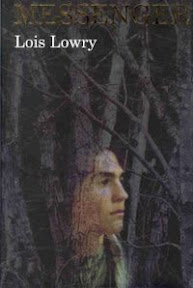
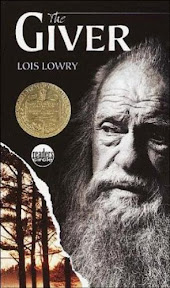
The Giver and Messenger

I really had no plans to pick either of these books up. I knew that Lowry had written a sequel of sorts to a favorite childhood book of mine, The Giver, called Gathering Blue. For the Young Adult Reading Challenge, I picked up Gathering Blue (you can read my review here). Then I found out that Lowry had written a third book, Messenger, which united characters from both books. I decided then and there to reserve both The Giver and Messenger from the library, so that I could have the full experience.

It was a very long time ago that I first read The Giver. The book had just won the Newberry Medal, and I remember very distinctly what an impression this book made on me. If pressed, I would probably categorize The Giver as science fiction, because it is about a utopia, which of course is not quite so perfect as it seems on the surface. The book is deceptively simple. It is written as a children's story, with simple language and uncluttered writing, but rereading it as an adult, I found much more in this profound story than I did as a child.

The Giver's main character is a boy named Jonas, who lives in a perfect society. There is no conflict, poverty, hunger, divorce, injustice, unemployment or inequality. Everyone in the community has their own role; everyone takes pride in their duties. Everyone is safe at all times. As the story opens, Jonas is feeling anxious about the upcoming Ceremony of Twelve where he and the other Elevens are to be given their adult job assignments.

His father explained to Jonas:
..."It's the last of the Ceremonies, as you know. After Twelve, age isn't important. Most of us even lose track of how old we are as time passes, though the information is in the Hall of Open Records, and we could go and look it up if we wanted to. What's important is the preparation for adult life, and the training you'll receive in your Assignment."

Despite the fact they have been observed closely by the Elders in order to select occupations that will match their interests and personalities, Jonas can't figure out what he could possibly be selected for, and the uncertainty bothers him. But at the Ceremony, Jonas is surprised when he is selected for the role of Receiver. He knows that the job is one of great importance to the community, but he is unprepared for what it holds in store for him. He is put in training with an old man he knows only as The Giver. The Giver teaches him that his job is to receive and store all memories of a past before the community and its perfection existed. Exposed to these secrets of his society, Jonas finds that he is terribly burdened and separated from everything and everyone he has ever known.

I think Lowry's genius in this book is in creating characters that the reader genuinely cares about. Jonas never questions the rules of the community until he is given the memories he must receive and learns about both the horrors and the joys that exist outside of his world. Even then, he feels dutiful to his role and makes the decision to sacrifice of himself in order to help others.

The community where Jonas lives is perfectly thought out and detailed. An older reader will suspect right away that things aren't as perfect as they seem in the community (since dystopias after all are a rather popular science fiction topic). Even so the way Lowry shows us first the perfect surface of the society and then gradually exposes us to its flaws is quite elegant.

This book is, of course, also accessible to younger readers as well, since it is designed for them. It might be the first exposure to a science fiction book for a younger reader (I'm pretty sure it was for me) and there is really no better book.

The Giver has become a classic, and deservedly so. If you haven't read it, you have it on my authority that it should be added to your tbr pile asap!

Now on to Messenger. This book picks up from the events at the end of Gathering Blue, but switches narrators. Kira, the main character of Gathering Blue, was learning to find her place as a disabled person in a society that discarded those with imperfections. Matty was Kira's scrappy, mischievous friend, and at the end of the book, he made the decision to leave the place where he and Kira lived, finding his way instead to a different Village where outsiders were welcomed, the helpless and injured are cared for, and everyone lives in harmony. He lives with Kira's father, a blind man called the Seer. His job in the village has been to deliver messages, a role he relishes because of the challenge. Delivering messages frequently takes him through the old Forest. Matty has never had trouble from the Forest, but unwary travelers have been stranded, hurt, and even killed by the Forest.

There is a growing unrest in the Village, though, and Matty must take on his most challenging journey yet. Some of the Villagers have grown tired of taking in new refugees and the borders of the Village are being closed. Before then, Matty must return to his home village and try to convince Kira to return back with him before it is too late.

After recommending both The Giver and Gathering Blue as must-reads, I wish I could say the same for Messenger. It isn't a terrible book, but it just isn't as good as the other two. The Giver and Gathering Blue are connected by the faintest strand, and I'm sure that over the years more than one reader, and perhaps publisher has begged Lowry to connect the two books more concretely. The resulting book feels a bit half-hearted. The characters are there, but the subtle magic that made the previous two books great is just not there. At the end of this book, I had more of a so-what? reaction. If you have read the other two books and liked them, you might want to read this one just to see what happens. Otherwise, as a stand-alone novel, it doesn't hold up.

Sunday, April 13, 2008

Sunshine

Author: Robin McKinley
Rating 2.5/5
Reason for Reading: Once Upon a Time Challenge, Mythopoeic Award Challenge

Sunshine lives a normal life in a normal city. She spends most of her time at the family cafe baking cinnamon rolls and creating new recipes. One night she drives out to the lake, where her normal life takes a sudden turn.

"I never heard them coming. Of course you don't, when they're vampires."

She is taken to a lake house and chained up in the ballroom next to another vampire. Certain she will never see the light of day again, she is shocked when she sees that he is chained to the wall as well.

He tells her: "Speak. Remind me that you are a rational creature."

Frightened beyond belief, she obeys. When he doesn't harm her after a full day together, she plans an escape attempt, and impulsively includes him. Once back to her real life, she struggles to reconcile her act of compassion to Con, the vampire, with the fact that humans are mortal enemies of vampires.

I've posted before about my love-hate relationship with McKinley's works. You can read my full sob story here, but to sum it up, some of her books rank in my top all-time favorites, but a few others have really disappointed me. So for my reading challenges, I decided to try one more of McKinley's works to see I could fall in love all over again. I was very excited at first about this book, because it started off solidly with an interesting premise. Sunshine is a smart, feisty character, and the development of the relationship between her and the vampire was very fascinating. The world Sunshine lives in is practically identical to our own except for the fact that vampire, demons, angels, pixies, and other fantastic creatures share it.

I was really hoping the rest of the book would include more action and adventure, but instead, it spent a lot of time giving us Sunshine's long, rambling thoughts, revealing details about the extensive cast of supporting characters, and building up to a conclusion that I thought left too many loose ends. I personally wanted to know more about Con, the vampire, because he was the most interesting character in the book. I thought there were too many characters, and I kept getting them confused. In addition, Sunshine had so many metaphysical revelations about the people, objects and relationships in her life that took pages to explain that I lost track of the storyline at some points.

Other fans of McKinley's work or of the vampire genre might disagree with my criticisms and find this book enjoyable.

Monday, March 24, 2008

The House of the Scorpion


Author: Nancy Farmer
Challenge: YA Lit Challenge
Rating: 5/5

After some of the heavy reading I've been doing lately, it was nice to read a book that I didn't have to force myself to read. I'd run out of adjectives long before I'd fully describe this book, but let's start with engrossing, thought-provoking, and page-turning.

On the border between the US and what used to be Mexico is a vast region of drug kingdoms called Opium, where the powerful drug lords live on enormous sprawling estates and illegals that have been unlucky to be caught trying to cross the border toil away as slaves. The most powerful drug lord is El Patrón, and on his vast estate lives his extended family, friends, and also a young boy named Matt. Matt is different from the other children on the ranch. He was harvested from a cow at birth, and his foot bears the words "Property of the Alacrán Estate". He doesn't know why everyone in the household despises him, he doesn't know at first what it means when they call him a filthy clone.

Still, despite the malice and backbiting of the Alacrán family, Matt finds allies: his bodyguard, Tam Lin teaches him about the dirty reality of Opium that lies behind the manicured lawns and ornately decorated hallways. His caretaker, Celia, who spends all her energy keeping him safe from the schemes of the Alacráns.

Matt has a destiny. Matt rides through the opium fields, dreaming that El Patrón wants him to one day run the estate, but El Patrón had Matt created for his own selfish, life-prolonging purposes. After 140 years, his life is sustained by little more than a thread, and his next heart attack could mean the end for Matt.

Even though I was rereading this book, it was once again, unputdownable (is that a word?). I read it straight through in one sitting. It is a deceptively simple at first, just a story about a clone (not an unusual topic in scifi) but Nancy Farmer writes so beautifully and keeps us engaged in the Matt's story. It is a rarity in scifi to have an author who can write about concepts and keep the characters engaging, but this is that kind of book. Matt is a character that will stay with you. He has to fight, from birth, against impossible odds.

While very young, he lands in the care of a cruel housekeeper named Rosa, who imprisons him in a tiny room full of sawdust because she doesn't want the bother of caring for him. Nancy Farmer writes these chapters with an understanding of what a child might actually be thinking and feeling as they experience those horrors. They are not sloppy or sentimental, which makes them all the more powerful.

This is a book I recommend to you whether or not you read science fiction or YA fiction, because it simply transcends those labels. It is a breath-taking read, and I promise the story will grab you and not let go.

Saturday, February 9, 2008

Anansi Boys

Author: Neil Gaiman
Rating: 5/5
Challenge: Mythopoeic Award Challenge

I really liked American Gods, so I wasn't sure what to expect from this book. Sometimes you read a book by an author you really like and they write another book that ends up being a retread of the previous book. And then you feel cheated. Anansi Boys, however, did not disappoint. It is similar to American Gods only in the fact that both contain gods (and the always-charming Mr. Nancy). Everything else - tone, length, characters, plot - is completely different. You wouldn’t have to read American Gods to understand Anansi Boys, and even elements that occurred in the first book (the world that the gods inhabit, dead characters, the interaction between gods and people) are handled differently so that everything is still fresh and interesting.

Anansi Boys turns its focus exclusively to the African pantheon of gods. Anansi, the trickster spider god is dead, and Fat Charlie, his straight-laced, somewhat bumbling son learns not only that his dad was a god, but that he has a brother he has never met before.

Where American Gods is serious, this book is light-hearted and nimble. Fat Charlie's brother, Spider is a stitch. Endowed with the powers of the gods, a trickster god as a father, and a large sense of his own self-important, he is cocky, charming, and not the type of houseguest you’d want. Especially when he pretends to be Fat Charlie and starts putting the moves on Fat Charlie’s fiancée, Rosie.

Spider was sitting at the kitchen table, enjoying a steak large enough for two people.
"Where did you get that from?" said Fat Charlie, although he was certain he already knew....
"It was in the fridge."
"That," declared Fat Charlie, wagging his finger like a prosecuting attorney going in for the kill, "that was the steak I bought for dinner tonight… for me and Rosie. The dinner I was going to be cooking for her! And you’re just sitting there like a, a person eating a steak, and, and eating it, and-“
“It’s not a problem,” said Spider
“What do you mean, not a problem?”
“Well,” said Spider, “I called Rosie this morning already, and I’m taking her out to dinner tonight. So you wouldn’t have needed the steak anyway.”
Fat Charlie opened his mouth. He closed it again. “I want you out,” he said.
“It’s a good thing for man’s desire to outstrip his something or other – grasp or reach or something – or what else is Heaven for?” said Spider, cheerfully, between mouthfuls of Fat Charlie’s steak.”
“What the hell does that mean?”
“It means I’m not going anywhere. I like it here.”

After Spider uses his god-powers to kick Fat Charlie out of his own home while he romances Rosie, Fat Charlie flies back to his hometown to get some wisdom on how to get rid of Spider. He makes a deal with one of the ancient animal gods to get Spider out of his life but gets more than he bargained for when masses of birds start attacking the two of them. This sets off a set of adventures where Fat Charlie and Spider have to work together to stay alive.

This is a book with vivid characters and an offbeat sense of humor. The relationship between Spider and Fat Charlie is funny and touching. Things might get dangerous, but if the two brothers can learn to work together, they can save the day and their respective women from mortal peril. Neil Gaiman is a new favorite of mine, so I have to give a special thank you to the bloggers who introduced me to his work.

Monday, January 28, 2008

Book Review: American Gods

Author: Neil Gaiman
Rating: 4/5
Challenge: Mythopoeic Award Challenge

I’m planning on reading Anansi Boys for the Mythopoeic Award Challenge, but I figured while I was at it, I would read American Gods first, since it was written first. I have this weird thing about wanting to read first books first.

Anyhow, American Gods starts out by introducing us to Shadow, who is a man down on his luck. He’s on the verge of being released from jail when he learns that his wife, Laura was killed in a car accident. On his way to her funeral, he receives an unusual job offer from a man who calls himself Mr. Wednesday. Mr. Wednesday needs a bodyguard and Shadow reluctantly accepts, figuring he has nothing else better to do. While accompanying Mr. Wednesday, Shadow meets a number of people who turn out to actually be gods. Yes, gods. We learn that even when belief in the mythological gods of old waned in America, the gods themselves live on. They may blend in with the rest of us normal folks, they may be down on their luck, but they are still here.

Wednesday is rallying the troops (so to speak) to battle against the new gods (Media, Internet, Highway, anything else Americans really believe in, etc., etc.) but it is not as easy as it sounds; most of the gods don’t really want to fight. Mr. Wednesday’s main compadres in his mission are Mr. Nancy (Anansi, the African trickster god) and Czernobog ( a dualistic Slavic god). Shadow accompanies Mr. Wednesday on a number of missions to convince the gods to fight, but things really get rolling when Wednesday is murdered. Furious, all the gods gather together for a last dramatic battle.

All sorts of gods, folk heroes and legendary creatures of all sorts of cultures populate this book, and Gaiman brings them to life unforgettably. What would it be like to have dinner with Easter, now living as a hippie in San Francisco? How about running into a leprechaun in a bar?

The bearded man lit his cigarette. “I’m a leprechaun,” he said, with a grin.
Shadow did not smile. “Really?” he said. “Shouldn’t you be drinking Guiness?”
“Stereotypes. You have to think outside the box,” said the bearded man. “There’s a lot more to Ireland than Guiness.”
“You don’t have an Irish accent.”
“I’ve been over here too f-ing long.”
“I told you. I’m a leprechaun. We don’t come from f-ing Moscow.”
“I guess not.”

The book is structured as an action book, and a mystery. Shadow hardly has a moment to recover from the shock of learning his wife is dead before he is being whisked away to convince other gods to join Wednesday's cause, all the while being pursued by a shadowy agency who seem determined to kidnap him. It is also structured like a mystery, because we are trying to determine as we read along why a dead character who keeps popping up won’t stay dead, how the gods came to America, what the true nature of the ultimate battle between the gods will be like, what Shadow’s mysterious dreams about a buffalo-headed god really mean, and most importantly, why exactly Shadow is so important to both the old and new gods. We get little hints dropped tantalizingly throughout the book, and I was impressed by how each thread was tied up by the end.

There were a number of interesting themes woven throughout this book. First and foremost, the book explores what Americans worship nowadays. Shadow is faced with this when Lucille Ball starts talking to him from the TV.

“Who are you?” asked Shadow.
“Okay,” she said. “Good question. I’m the idiot box. I’m the TV. I’m the all-seeing eye and the world of the cathode-ray. I’m the boob tube. I’m the little shrine the family gathers to adore.”
“You’re the television?”
“The TV’s the altar. I’m what people are sacrificing to.”
“What do they sacrifice?” asked Shadow.
“Their time, mostly,” said Lucy. “Sometimes each other.”

That passage struck me as being very profound. It actually made me think about how much time I myself sacrifice to my TV. Really, what makes the TV so different from altars to Baal or Odin or Kali? People certainly sacrifice plenty of time, money, and definitely relationships to the TV.

The one thing that kind of bugged me while reading this book is: why does Shadow follow along with the old gods? Sure, the new gods are heartless and soulless, but the pagan gods aren’t necessarily spotless heroes themselves. Wednesday uses his powers to charming people into handing over their money and seducing waitresses. The Queen of Sheba poses as a prostitute but then swallows the johns whole. Many of the gods discuss receiving human sacrifices with pleasure; Shadow has a disturbing dream where he encounters Odin in Valhalla, where the trees are overhung with animal and human sacrifices in Odin’s honor

Shadow puts it this way: “It occurred to him that the reason he liked Mr. Wednesday and Mr. Nancy and the rest of them better than the opposition was pretty straightforward: they might be dirty, and cheap, and their food might taste like shit, but at least they didn’t speak in clichés.”

Is that really enough justification? The gods are revealed to be liars, cheats, and they downright betray their own kind. So maybe we’re better off not believing in them anymore. Or maybe I’m really just missing the point, because none of the things that the gods do in this book are any different from what they do in any of the mythologies or stories. In Greek mythology, Zeus of course cheated constantly on Hera and fathered all sorts of godlings. All of the gods constantly ganged up on each other and fought all sorts of unnecessary battles and sometimes helped and sometimes tormented humanity.

Looking at it that way, I guess I need to go dig up some more mythology. I might want the gods to act more honorably, but wouldn't that betray what they are supposed to be?

This was an intriguing and fast-moving read. If you were ever the kid who was real interested in the Greek Mythology unit in English class, definitely read this book.

Monday, January 7, 2008

... Yet More Resolutions

The beginning of the year is a fabulous time to get interested in book challenges. There are so many starting right now that I felt like a kid in a candy store browsing around and picking which ones I wanted to join. Since I started this blog (a few short days ago) I've been dipping my toes in the pool of book challenge goodness, and now I'm taking the plunge (so to speak).

So here goes. I'm joining 7 challenges so far this year, and I hope it will actually become more!


I have already posted about the , but here's my reading list so far (almost all books mooched from the parents):

Books/Stories by Philip K. Dick
A Scanner Darkly
Our Friends From Frolix 8
Paycheck
The Minority Report
The Man in the High Castle
Flow My Tears, the Policeman Said
I Hope I Shall Arrive Soon
Radio Free Albemuth

Books by Ray Bradbury
The Toynbee Convector
Something Wicked This Way Comes
Quicker Than the Eye
The Illustrated Man

The Planet That Wasn’t by Isaac Asimov
Transition by Vonda McIntyre


Short Story Challenge
For this challenge, I have choices between 10 short stories during 2008 or 10 short story collections. I haven't finished my reading list, but this is the start:

Smoke and Mirrors by Neil Gaiman (collection)
Old Times on the Missippi by Mark Twain (story)
Do Androids Dream of Electronic Sheep? By Philip K Dick
The Overcoat by Nikolai Vasilievich Gogol

I'm planning to keep up to date on this one by participating in the discussions on A Curious Singularity


I really like this one. I get to pick 7 titles from the books which have contended for the Mythopoeic Award. I might have to add more as I get more into this one:

Little, Big by John Crowley
Seventh Son by Orson Scott Card
A Hat Full of Sky by Terry Pratchett
Anansi Boys by Neil Gaiman
Mortal Love by Elizabeth Hand
Sunshine by Robin McKinley
House of the Scorpion by Nancy Farmer


In Their Shoes Challenge
For this one, I'm reading however many books I want to that are autobiographies, memoirs, or biographies:

Eat, Pray Love Elizabeth Gilbert
A Million Little Pieces by James Frey
A Long Way Gone: Memoirs of a Boy Soldier by Ishmael Beah
Candy girl: a year in the life of an unlikely stripper by Diablo Cody.
The year of magical thinking by Joan Didion
Paula by Isabel Allende
Ten Thousand Sorrows by Elizabeth Kim


Young Adult Reading Challenge
For this one I'm reading 12 Young Adult Books. I haven't had the time to quite finish this list either, but I figure I'll browse the library as I check out new books. Now that I've finally figured out where the YA section is:

Feed by M.T. Anderson
House of the Scorpion by Nancy Farmer
The Chocolate War by Robert Cormier
The Blue Girl by Charles de Lint
Esperanza rising by Pam Mu~noz Ryan
Gathering Blue by Lois Lowry
A Great and Terrible Beauty by Libba Bray


Chunkster Challenge
For this I was a little apprehensive... 4 books in 2008 that are 450 pages or longer. But then I realized I already have a chunky book that I've started on, and another I'm planning to read for the Year of Reading Dangerously Challenge. So... easy peasy:


War and Peace
The Once and Future King by T.H. White
The Blind Assassin by Margaret Atwood
Great Expectations by Charles Dickens


My Year of Reading Dangerously
The point of this one is to read books that are challenging, or at a minimum ones you don't normally read. This one comes with an official list, which I'm going to stick with so far. The one that sounds the scariest for me is Great Expectations. Hope I can find all of these books in the library! If not, there will be some substitutions.

January: Great Expectations, by Charles Dickens
February: The Bluest Eye, by Toni Morrison (African American)
March: Cat's Eye, by Margaret Atwood (Atwood for Atwood's sake)
April: Transformations, by Anne Sexton (Poetry)
May: Other Voices, Other Rooms, by Truman Capote (Southern)
June: Lolita, by Vladimir Nabokov (Russian)
July: The Chocolate War, by Robert Cormier (adolescent)
August: Maus I and II, by Art Spiegelman (Graphic Novel, Pulitzer winner)
September: The Secret Lives of People in Love, by Simon Van Booy (Independent)
October: The Human Stain, by Philip Roth (Contemporary/Jewish)
November: A Month of Classic Short Stories, Various
December: The Grapes of Wrath, by John Steinbeck (Dusty)