Subscribe

RSS Feed (xml)

Powered By

Skin Design:
Free Blogger Skins

Powered by Blogger

Showing posts with label in their shoes challenge. Show all posts

Monday, January 12, 2009

Confederates in the Attic

The third in a series of mini-reviews because my lazy butt is way behind on book reviews.

Confederates in the Attic: Dispatches from the Unfinished Civil War by Tony Horwitz
Reason for Reading: In Their Shoes Reading Challenge
Rating: 4.5/5

The only reason I'm rating Confederates in the Attic 4.5/5 instead of 5/5 is because a few of the chapters are really, really long. I had to skip one of them, because the word 'Civil Wargasm' was getting on my nerves.

Otherwise, an amazing, eye-opening book. Tony Horwitz took his childhood interest in the Civil War to a new level by traveling around the South in search of Civil War relics, battle fields, and most importantly stories. Evenhandedly and well-presented are the many people he encounters with an Obsession (capital O) with the Civil War. Some he meets are reenactors of both the hard-core (weekend-long marches in ill-fitting boots, spooning with fellow soldiers for warmth to have the most authentic experience) and farb (Anything short of hardcore, but mostly showing up for big battle reenactments) variety.

Many of the civil-war obsessed he meets in the South, however, are obsessed with the mythology of the Confederacy. All are inevitably white, most are racist, and all seem to subscribe to a revisionist history of the Civil War that makes them resistant, 150 years later, to Yanks. There are clubs for Daughters of the Confederacy, Sons of the Confederacy, and clubs to teach your kids about the principles of Southern Pride.

Horwitz also examines the Shiloh battlefield, interviews Shelby Foote (famous Civil War historian) and takes the reader on a close-up view of Andersonville, the notorious POW camp where captured Union soldiers were luckily to survive long enough to be released.

Should I read it? If you have even the slightest interest in the Civil War, you'll find at least one of the chapters of this diverse book fascinating.

Thursday, December 11, 2008

Hurry Down Sunshine

Hurry Down Sunshine by Michael Greenberg
Reason for Reading: In Their Shoes Reading Challenge
Rating: 4.5/5

Hurry Down Sunshine, according to the dust cover "tells the story of the extraordinary summer when, at the age of fifteen, Michael Greenberg's daughter was struck mad."

It starts when Sally is struck with a vision on the streets of Greenwich that ultimately leads to her being brought home by the police, and soon it becomes obvious the only choice left is a psychiatric ward.

This is the story of the sweltering summer that Sally spends there, and the effect on Greenberg, his wife, Sally's mother, brother and grandmother. How do you convince a family member who has not witnessed your daughter's crack up that she really does belong in the psychiatric ward? What do you say when medications have thrown her so off balance she can't concentrate? When she tells everyone you've locked her up?

Greenberg's memoir is lyrical and honest. He describes the confusion, the frustration of dealing with a mental illness. The desire to believe they are not really sick, the haunting question of whether or not you are somehow to blame, wanting, so desperately for your loved one to be lucid again.

"Tell me what I'm doing here," she says, puzzled and child-like, her eyes as black as malachite, magnified and sharp."

"You're here to feel well again."

"I've never felt better. I'm perfectly fine."

"You haven't been acting fine."

"Everyone's acting, Father. You most of all."

"Sally, you're sick." I hear the flat insistence in my voice.

"Sick. Mmm. Does it make you safer to think of me that way?"

"We just want you to be well again."

"Your father doesn't mean that you're not yourself right now," says Robin. "He means, you're here, in the hospital to... recover."

Sally seizes the word. "Recover," she repeats. "But what have I lost? Or am I someone you want to cover up again. Someone you want to put a lid on." Her voice hardens: the dreaded inquisitorial tone. "You've always wanted to lock me up, Father. Now you've succeeded. You must be very satisfied with yourself."

Greenberg writes without sentimentality, or excessive emotion. He doesn't have to, the simple facts of what happened, the dialogue tell us how difficult the experience was. My only regret is that the novel ended before I was quite ready. In my eagerness to read, I felt that it was abrupt, although he did give a bit of a postscript to explain what Sally had done since the summer he describes in the book. Still, this one is highly recommended.

Saturday, July 5, 2008

Marie-Therese, Child of Terror

Author: Susan Nagel
Reason for Reading: In Their Shoes Reading Challenge
Rating 4.5/5

Marie-Therese was a celebrity from the moment she was born in front of an adoring crowd of onlookers. If I tell you that her mother was Marie-Antoinette, though, you have some idea of how the fairy tale ended. While still very young, Marie-Therese, along with her family, was placed under house arrest and eventually imprisoned in the France's Temple Prison.

She was kept ignorant of her mother and father's death, and was forced to listen to the cries of her brother as he was tortured in an adjacent cell. Eventually she was allowed to leave, and spent much of the rest of her life in exile, waiting for the Monarchy to be welcomed back to France. Until her dying day, she believed in France and represented the hope for the future of France.

I enjoy history, but I remembered very little of this time period from my college history course. Susan Nagel writes passionately and sympathetically about the monarchy of France. Marie-Therese lived an amazing, almost unbelievable life. From her childhood in the fairy-tale palace of Versailles, she faced her country's largest civil crisis with incredible endurance. She lived as an exile, dependent upon her royal cousins abroad for support, as a returned monarch, and was the subject of much speculation. Had she actually been switched with her half-sister and lived out her life as "The Dark Countess"?

This book was an excellent recounting of a tumultous period of history and an amazing woman who came to symbolize France. I had only a very minor complaint, and it has nothing to do with the actual book, but rather the marketing of the book. In the description, it focuses itself on the fact it will be exploring the mystery of whether or not Marie-Therese had been switched with her half-sister. I was expecting the book to be an in-depth examination of the mystery. Actually, the resolution of the mystery with all the research Susan Nagel did was an afterward.

If you have any interest in history, France, and/or interesting heroines, I can definitely reccommend this biography.

Other reviews:
Book-a-rama
In the Louvre

Thursday, May 29, 2008

Life is So Good

Author: George Dawson and Richard Glaubman
Rating: 5/5
Reason for Reading: In Their Shoes Reading Challenge

Cross-posted at In Their Shoes Blog

I won this book because of My Year of Reading Dangerously Challenge (Yay!). The cover and title don't make it sound like an exciting read, but in reality, this was a fascinating, sometimes gripping read. George Dawson, the grandson of slaves, lived to be 103. The reason he became well-known (and thus this book was written) is because at the age of 98, he made the decision to learn how to read, a skill that had been denied him as a poor black man in the early 1900's.

In this memoir, George writes about growing up in the segregated south. As a young child, he witnessed a lynching of a man he knew to be innocent. While trying to process the horrifying experience, he has an exchange with his father:

"I will never work for or talk to a white person again," I said with anger.... Papa swallowed hard and pulled up on the reins so that the wagon stopped. He turned towards me. "No. You will work for white folks. You will talk to them... Some of those white folks was mean and nasty. Some were just scared. It doesn't matter. You have no right to judge another human being. Don't you ever forget." My father had spoken. There was nothing to say. I didn't know it then, but his words set the direction my life would take even to this day.

George had a good many adventures during his life, from playing on the Negro Leagues to riding the rails all the way from Mexico to Canada and everywhere in between. He recounts his experiences during The Great Depression, the Civil Rights movement and other turning points of the past century.

I could outline all of the events of the book, and really it wouldn't capture what the book is exactly about. Yes, the book brings the reader through the dirty underside of racism, but that isn't what the book is about either. He experienced many of the things most of us only know from history books, and it included a great deal of hardship. I guess you could say that this book is an attempt to tell his story, and recount how he managed to maintain his dignity and optimism through all of it.

George Dawson is a truly remarkable man. After joining an Adult Education class, he stayed with it until he had earned a GED. He seems a bit incredulous that so many people are fascinated and inspired by him, but glad to talk to people and help them all the same. You'll be glad you read this book.

Saturday, May 3, 2008

Candy Girl: A Year in the Life of an Unlikely Stripper

Author: Diablo Cody
Reason for Reading: In Their Shoes Reading Challenge


Also posted at In Their Shoes Blog

After reading this book, I feel the need to justify why I wanted to read it so much. If you'll recall, I blogged about reserving it at the library back in January. The book is about how Diablo Cody (the genius behind Juno) went from working a normal 9-5 job at a copy-ad agency to becoming a stripper. At the time she impulsively switched careers, she was living in Minnesota, my home state. So I knew the book was set in Minnesota, and of course I knew it was about stripping, but I was perhaps a bit naive about the sex industry, since my closest encounter with it is walking past an upscale strip joint on the way to a favorite Irish pub. So that's my excuse as to why I was reading a book about a stripper. Naivete.

I am naive no more. After she is finally burnt out with stripping, Diablo describes the stripping scene as:

"Hundreds of girls on the floor at some clubs, all reduced to begging dogs for an army of smug little emperors. The rules of attraction were reversed at a strip club. Girls that could halt midday traffic at Nicollet Mall were rejected by fat guys wearing Zubaz. Joe Punchcard with $20 could toy with several dancers over the course of an afternoon, finally selecting the one who'd receive the dubious privilege of entertaining him for three and a half minutes.... It's like a girl buffet."

Now granted, throughout most of the book Diablo finds stripping hard work but a definite thrill. She is drawn to an "Amateur Night" sign at a seedy dive and first gets a taste. Soon she finds herself working 2 nights a week at Schiek's (incidently the very same upscale strip joint that I walk past on the way to the pub) while still holding down her regular job. Eventually she quits her day job and gets into stripping full time, eventually working at the peep show in Sex World (another Minneapolis institution that I've driven past frequently).

So what is the book about? (besides stripping of course). It's a fish-out-of-water story. It's about the various people, some funny, some nice, some disgusting, that Diablo encountered while stripping. It's about what actually goes on behind the scenes at the strip clubs. It's about her journey from seeing stripping as her last chance to rebel against convention to finally burning out and leaving the business just as suddenly as she entered it. Diablo is a very funny, sarcastic writer.

"At a strip joint... a new girl might as well don veal underwear and dance the Watusi through a gauntlet of jackals. Most veteran strippers are punch-drunk on Haterade and they'd sooner dredge their Vuitton clutch in a cow pie before mustering a pixel of common courtesy toward their fellow woman."

Throughout the book, Diablo continues to try and explain what made her stick with stripping. The main things are the money and just getting a thrill out of doing something as un-normal as her life up to this point has been normal.

She doesn't romanticize stripping or shy away from showing what it is really like. This was just my take, but her descriptions of how the whole thing worked made me more sad than anything. As Diablo quickly learned, the line between strippers and prostitutes is thin at times. The best money is made by taking customers to private booths and simulating sex. While strippers can make a great deal of money in a night, they pay a large cut to the house. She describes meeting the owner of one of the stripjoints and realizing that the outlandish cuts she's been paying out have been lining his pocket much more than her own. Though she never uses the word exploitation in her book, it was clear from her book that it is the whole premise of a strip club.

Do I recommend this book? Yes and no. Definitely no if anything in my review made you squeamish, because I have not even come close to describing some of the most graphic parts of her book. Yes, if you like Diablo Cody's sense of humor in Juno and if the premise is appealing to you. For the second book review in a row, I can't possibly hope to rate this one accurately. I thought it was excellently written, but the subject matter got to me after a while. Despite that, I will say that I'm glad I read it.

Sunday, March 30, 2008

Nickeled and Dimed

Author: Barbara Ehrenreich
Rating: 5/5
Reason for Reading: Recommendation by Eva, In Their Shoes Reading Challenge

Poverty, especially in relation to Welfare is an uncomfortable topic. Get two people with different viewpoints going on the subject, and your carefully planned dinner party could quickly end in disaster.

Barbara Ehrenreich, who in normal life spends her time as a writer, decided to spend 3 months as a blue-collar worker to see what it was like to live on the wages offered by the likes of Walmart and other low-paying jobs of similar ilk.

The result is a fascinating first-hand account of the struggle to make ends meet on meager wages. Ehrenreich started as a waitress in Key West, then a maid and dishwasher in Maine, and finally as a Walmart employee in Minnesota.

She reports in the introduction that "The first thing I discovered is that no job, no matter how lowly, is truly "unskilled". Every one of the six jobs I entered into in the course of this project required concentration, and most demanded that I master new terms, new tools, and new skills."

Ehrenreich reports on the exhaustion of standing on her feet for 8 or more hours in a row, the humiliation of mandatory drug tests, having her first paycheck held (as is the custom in many low-paying jobs), the managers who spend all their time looking over everyone's shoulder to yell at the smallest mistake, the seedy rent by the week motels she stayed at, and the complete and utter inadequacy of $7 an hour to pay for all of the lodging, food, clothing, and payphone expenses.

Among her coworkers, those who are not lucky enough to have a boyfriend, parent or child to split housing costs with have found solutions such as sleeping in their cars or staying at cheap motels. While working as a maid, Ehrenreich reports a particularly harrowing story about a coworker who apparently eats next to nothing. When she trips in a hole and hears something snap, she refuses medical attention because there are no sick days, and besides, she doesn't have any insurance. Ehrenreich recalls reaming out their boss over the phone to let her coworker have the day off. The next day, she went to work, uncertain if she would still have a job.

At the maid company, most of her coworkers had injuries of some kind or another from the hard work, even though the pay is sparse. Reflecting on the toll exacted on the maids, Ehrenreich states:

So ours is a world of pain-managed by Excedrin and Tylenol, compensated for with cigarettes and, in one or two cases and then only on weekends, with booze. Do the owners have any idea of the misery that goes into rendering their homes motel-perfect? Would they be bothered if they did know, or would they take a sadistic pride in what they have purchased-boasting to dinner guests, for example, that their floors are cleaned only with the purest of human tears?

This book like this was a glimspse into a world I've never been a part of, not really. Personally, my closest brush with poverty came when I returned from a semester abroad and spent a desperate month with no money in reserve and grocery and rent to pay. But even then, I had advantages most poor do not. My fiancee (now husband) bought me groceries and an extra student loan came in just enough time to keep me from overdraft fees. The memory of how humiliated I felt at having to ask someone else to buy me groceries (even though it was my fiancee!) has made me very determined in life not to wind up in the same situation. But to be forced into that position not for a month, but for years and years, with little possibility of change.... it is truly beyond my power of imagination. Ehrenreich's story brings a much needed human element to the discussion on welfare reform and poverty. She is an excellent writer, and she weaves her own stories along with that of her coworkers into a compelling and moving read.

Wednesday, February 6, 2008

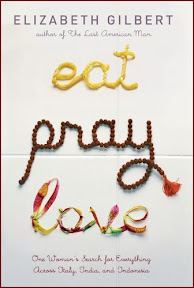
Eat, Pray, Love

Author: Elizabeth Gilbert
Rating: 3.5/5
Challenge: In Their Shoes Challenge

I first heard about this book when Oprah was interviewing Elizabeth Gilbert on her show, and my initial thought was “yeah it would sure be great to have the time and money to just up and travel around the world for a year,” which is what Gilbert did when she was attempting to recover from a bitter divorce and her ensuing depression. I wrote this book off thinking that it sounded awfully frivolous. However, it ended up in my tbr pile thanks to my aunt loading me up with a pile of books, and I’m glad I read it. Gilbert is a terrific and very relatable writer and what sticks out during this memoir she wrote about her journey towards spiritual recovery is that she not only funny, but very very honest about herself, her struggles, and her passions in life.

Gilbert embarked on a year traveling to Italy, India, and Indonesia in order to find inner peace to recover from her demons. In each respective country she had a different focus, and they are (you’ll never guess this one): eating, prayer, and love.

I visited Italy for one short week while studying abroad, so I really enjoyed the section where she describes wandering the streets of Rome, eating gelato and pasta every day, making new friends with the Italians she meets, learning Italian and in essence studying pleasure. “Sometimes I wonder what I’m doing here, I admit it. While I have come to Italy in order to experience pleasure, during the first few weeks I was here, I felt a bit of panic as to how one should do that…. When I realized that the only question at hand was, “How do I define pleasure?” and that I was truly in a country where people would permit me to explore that question freely, everything changed. Everything became… delicious. All I had to do was ask myself every day, for the first time in my life, “What would you enjoy doing today, Liz?”

Gilbert does a wonderful job of incorporating personal insights like that into stories of the friends she makes, and reflections on the country and the language she’s learning. She describes the pure pleasure of buying an asparagus from a street vendor, speaking the whole time in Italian, a language she hadn’t spoken a word of only a few months ago.

Finally, after 4 months in Italy, she has finally begun to recover mentally and physically (putting on 35 pounds!). She then flies off to India to spend time at an ashram (basically a place to meditate for hours and learn about Yoga).

The middle section is my least favorite in the book. I lost interest partly because she narrows her focus to her own spiritual insights to the exclusion of all the interesting anecdotes and insight about living in another culture I liked so much before. But I also found her theology, a conglomerate of different Yogic ideas, and a healthy dose of whatever-floats-your-boat must be God grating. I’m all for understanding and acceptance among different religions, but she basically creates her own religion out of a mish-mash of different ideas she liked. The one redeeming part of this section is her friendship with Richard from Texas, who gives her both the nickname Groceries and sage advice with a touch of gruffness like this: “Groceries, baby, listen to your friend Richard. You go set you lily-white ass down in that meditation cave every day for the next three months and I promise you this-you’re gonna start seeing some stuff that’s so damn beautiful it’ll make you wanna throw rocks at the Taj Mahal.”

Finally Gilbert makes it to Indonesia, where we get back to the lovely writing that drew me in to the book in the first place. She has a knack for bringing the friends she made on her trip to life in a believable manner. The medicine man who gives her direction at a critical time in her life. The healing woman who is on the verge of poverty but manages to adopt two street children because she can’t bear to see them abandoned. My favorite character, though, is the Brazilian man who she gradually allows herself to fall in love with, after finally coming to terms with the broken relationships she’s had in the past. Her time in Bali sounds so beautiful and carefree, I want to give up my career and move there myself.

So if you find yourself in the mood for traveling, but don’t have the time to take off a year, read Eat, Pray, Love instead.

Monday, January 7, 2008

... Yet More Resolutions

The beginning of the year is a fabulous time to get interested in book challenges. There are so many starting right now that I felt like a kid in a candy store browsing around and picking which ones I wanted to join. Since I started this blog (a few short days ago) I've been dipping my toes in the pool of book challenge goodness, and now I'm taking the plunge (so to speak).

So here goes. I'm joining 7 challenges so far this year, and I hope it will actually become more!


I have already posted about the , but here's my reading list so far (almost all books mooched from the parents):

Books/Stories by Philip K. Dick
A Scanner Darkly
Our Friends From Frolix 8
Paycheck
The Minority Report
The Man in the High Castle
Flow My Tears, the Policeman Said
I Hope I Shall Arrive Soon
Radio Free Albemuth

Books by Ray Bradbury
The Toynbee Convector
Something Wicked This Way Comes
Quicker Than the Eye
The Illustrated Man

The Planet That Wasn’t by Isaac Asimov
Transition by Vonda McIntyre


Short Story Challenge
For this challenge, I have choices between 10 short stories during 2008 or 10 short story collections. I haven't finished my reading list, but this is the start:

Smoke and Mirrors by Neil Gaiman (collection)
Old Times on the Missippi by Mark Twain (story)
Do Androids Dream of Electronic Sheep? By Philip K Dick
The Overcoat by Nikolai Vasilievich Gogol

I'm planning to keep up to date on this one by participating in the discussions on A Curious Singularity


I really like this one. I get to pick 7 titles from the books which have contended for the Mythopoeic Award. I might have to add more as I get more into this one:

Little, Big by John Crowley
Seventh Son by Orson Scott Card
A Hat Full of Sky by Terry Pratchett
Anansi Boys by Neil Gaiman
Mortal Love by Elizabeth Hand
Sunshine by Robin McKinley
House of the Scorpion by Nancy Farmer


In Their Shoes Challenge
For this one, I'm reading however many books I want to that are autobiographies, memoirs, or biographies:

Eat, Pray Love Elizabeth Gilbert
A Million Little Pieces by James Frey
A Long Way Gone: Memoirs of a Boy Soldier by Ishmael Beah
Candy girl: a year in the life of an unlikely stripper by Diablo Cody.
The year of magical thinking by Joan Didion
Paula by Isabel Allende
Ten Thousand Sorrows by Elizabeth Kim


Young Adult Reading Challenge
For this one I'm reading 12 Young Adult Books. I haven't had the time to quite finish this list either, but I figure I'll browse the library as I check out new books. Now that I've finally figured out where the YA section is:

Feed by M.T. Anderson
House of the Scorpion by Nancy Farmer
The Chocolate War by Robert Cormier
The Blue Girl by Charles de Lint
Esperanza rising by Pam Mu~noz Ryan
Gathering Blue by Lois Lowry
A Great and Terrible Beauty by Libba Bray


Chunkster Challenge
For this I was a little apprehensive... 4 books in 2008 that are 450 pages or longer. But then I realized I already have a chunky book that I've started on, and another I'm planning to read for the Year of Reading Dangerously Challenge. So... easy peasy:


War and Peace
The Once and Future King by T.H. White
The Blind Assassin by Margaret Atwood
Great Expectations by Charles Dickens


My Year of Reading Dangerously
The point of this one is to read books that are challenging, or at a minimum ones you don't normally read. This one comes with an official list, which I'm going to stick with so far. The one that sounds the scariest for me is Great Expectations. Hope I can find all of these books in the library! If not, there will be some substitutions.

January: Great Expectations, by Charles Dickens
February: The Bluest Eye, by Toni Morrison (African American)
March: Cat's Eye, by Margaret Atwood (Atwood for Atwood's sake)
April: Transformations, by Anne Sexton (Poetry)
May: Other Voices, Other Rooms, by Truman Capote (Southern)
June: Lolita, by Vladimir Nabokov (Russian)
July: The Chocolate War, by Robert Cormier (adolescent)
August: Maus I and II, by Art Spiegelman (Graphic Novel, Pulitzer winner)
September: The Secret Lives of People in Love, by Simon Van Booy (Independent)
October: The Human Stain, by Philip Roth (Contemporary/Jewish)
November: A Month of Classic Short Stories, Various
December: The Grapes of Wrath, by John Steinbeck (Dusty)