Subscribe

RSS Feed (xml)

Powered By

Skin Design:
Free Blogger Skins

Powered by Blogger

Showing posts with label ya reading challenge. Show all posts

Tuesday, September 8, 2009

Audrey Wait! (review)

Audrey Wait! by Robin Bentley
Reason for Reading: YA reading challenge
Rating: 3/5

Summarize the plot: Audrey is an ordinary girl until her ex-boyfriend writes a song vilifying her that becomes an international pop sensation. Suddenly she's famous, but it means having her every move make national television, and everyone, it seems, wants to be her friend. No one cares about the actual Audrey anymore.

One sentence review: A breezy, fun read that doesn't really stick with you afterwards.

What I liked: Audrey is a strong-willed character, if a bit dense at times. She has some true, loyal friends, who help her navigate the treacherous waters of instant fame, and the book has a lot of humor to it. The writing style kept me engaged, because it was light, cute, and fun. Also, I really enjoyed the understated relationship between Audrey and her love interest. It was never too in your face, or forced, and it never detracted from the main plot point - Audrey coming to terms with her new-found fame.

What I didn't like: There is a reason this book has a large blurb on the front by Meg Cabot. I'm not sure if Cabot should really be promoting it though, since Audrey, Wait!, is almost a blow by blow copy of the plot and style of The Princess Diaries. I enjoyed this light-hearted book while I was reading it, but when I started thinking too hard, and realizing how the plot lined up exactly with my favorite Meg Cabot read, I started liking it less and less. Both Mia (the protagonist of Princess Diaries) and Audrey are so irritated by all this new-found fame... lame-0... but it seems like most teenagers would have found at least something to enjoy from being famous. They both go through almost the exact same journey with friends, family, and paparazzi, coming to the same conclusions at the end. For some readers, that might not detract from your enjoyment, but for whatever reason, it did for me.

Should I read it? If you liked The Princess Diaries and don't mind the fact this book doesn't break any new ground, you'll probably love this one.

Monday, June 22, 2009

A Bunch More Reviews


Bring on the mini-reviews!

Zel by Donna Jo Napoli
Reason for Reading: Once Upon a Time Reading Challenge, YA reading challenge
Rating: 4.5/5
One paragraph plot summary: In this retelling of the classic story of Rapuzel, Napoli delves deeply into the psyches of Zel and her mother. Zel, who suffers many years of imprisonment in a lonely tower by herself, teeters close to the brink of madness, while her mother privately justifies to herself why she has taken such extreme measures to hide her daughter away from the world.

One paragraph review: Although this is a fantasy novel, Napoli manages to portray in a very short amount of space the helplessness, the craziness that Zel feels while she is imprisoned in the tower. Zel finds herself making friends with ticks and roaches to pass the time. The character of Mother is slyly written; although unhesitatingly evil, she is the only character who is written in first person, and we sympathize with her just a little, despite ourselves. If the romance between Zel and her suitor seems a bit thin, well, it is a fairy tale after all.


Laika by Nick Abadzis
Reason for Reading: Graphic Novel Challenge
Rating: 5/5

One paragraph summary: With the soviets having recently won the first battle of the space race with their successful launch of Sputnik One, the soviet premier had a new goal in mind: a live space traveler. Based on the true story, this graphic novel is about Laika, a dog who was the first living creature in space.

One paragraph review: Oh my. Where to start. First of all, if you know any history of the space program, you already know Laika's eventual fate. I knew it going in, but I still found myself hoping against hope for Laika to somehow survive the journey. This book is about Laika, but it is also about the true historical people who worked on the mission and the conflict they surely must have felt about sending a small dog on a one-way mission. Laika walked a delicate balance of appealing to the reader's emotions without oversentimentalizing the story, and I think precisely because of that, I was bawling by the end. (Note: I do not cry over books). Highly recommended.


The Perks of Being a Wallflower by Stephan Chbosky
Reason for Reading: YA Reading Challenge
Rating: 4/5

One paragraph plot summary: The book is a series of letters written by a teenager who calls himself "Charlie" to an anonymous person who he does not know personally. Each letter is like a diary entry as Charlie, a freshman in high school, talks about what's happening in his life, and reflects on trying to fit in or remaining a wallflower.

One paragraph review: Charlie is a heck of a narrator. He's shy, bookish, and a bit of an outcast, although he begins to find a place with a group of seniors at his high school. Although he feels most comfortable experiencing life from the outside, his new friends and a friendly English teacher help him to step outside his comfort zone. Chbosky takes the reader through all sorts of difficult topics that high schoolers face, and I think everyone will relate, at least a little, to Charlie.

Wednesday, May 6, 2009

The Book Thief

The Book Thief by Markus Zusak
Reason for Reading: IRL Bookclub, YA Reading Challenge
Rating: 5/5

The Book Thief is not easy to review. It is, at heart, a book about the everyday life of ordinary Germans during World War II. Anyone who has ever read Holocaust literature from the Jewish point of view wonders... why the heck did all the Germans go along with the Nazis? Why didn't more Germans help Jews?

The Book Thief is about Liesel, a young, illiterate German girl who winds up living with a foster family in Munich when her mother can't care for her any longer. She becomes the book thief before she has even learned to read, stealing a book from the grave digger who buries her brother. With the Hubermans, Liesel finds a haven. Hans, a kindly soul, teaches Liesel how to read, and she developes an intense passion for books, even daring to steal one from a Nazi book-burning.

The book follows Liesel and her family as World War II is about to erupt, and it is, above all things, a character study. We follow the lives of Liesel's proud foster mother, Rosa, who shows her affection by swearing at Liesel; Max the Jewish fist fighter that the Hubermans hide in their basement; Rudy, Liesel's best friend who never gives up hope that one of these days he will ask Liesel for a kiss and she will finally say yes; the mayor's wife who lets Liesel read the books from her extensive collection.

Life in the wartime is stressful for everyone. The neighborhood must deal with hunger, poverty, the threat of bombings, and the consequences of not following along with the Nazi way. Although he isn't able to directly fight against the Nazis, Hans Huberman finds ways to resist, from painting over anti-Semetic slurs on a Jewish neighbor's door to feeding a few Jews on their way to a concentration camp, to hiding a Jew in his basement.

Liesel, for her part, becomes a voracious reader, and when she can get away with it, a thief of books and whatever she and Rudy can find to eat. Her afternoons are spent reading with Max, describing to him the weather outside

What sets this book apart from other Holocaust reads is the choice of the narrator. Death, a reluctant collector of souls, tells Liesel's story. He is big fan of lists, strong imagery, and telling us about tramautic events in the story ahead of time. This sounds kind of odd at first. Why keep reading if you already know which characters are going to die and what's going to happen? However, it kind of clicked for me when I noticed that one of the people who blurbed the book (in my edition anyhow) compared it to Slaughterhouse Five. An excellent comparison. In Slaughterhouse Five, Billy Pilgrim learns that time, and by extension, death, is an illusion. Everything that has ever happened is still happening. So as character after character dies, the only thing that needs to be said is so it goes. They died a moment ago, but two more moments ago, they were alive and will always be alive.

Similarly, this book takes a more distant perspective of death. Death, weary and in need of a vacation, collects souls, and watches the colors of the sky which are different with each death. Everyone will come to him eventually, so the death of various characters is not painful, merely inevitable. And by telling us ahead of time who is going to die, Death makes the passing of characters we have come to love become less painful.

I'm really not describing very well how much Death's voice added to this book and how much I enjoyed it. The story is told to us in a very basic, factual fashion, but then every few pages, Death inserts his own commentary. He tells us what the characters are really thinking, and why various events are significant. Anecdotes about what his job is like. The book often reads like poetry thanks to Death's unique voice.

Should I read it? An unequivocal yes. I usually avoid Holocaust literature like the plague due to the heavy subject, but this book managed to keep me absolutely glued to the pages.

Tuesday, March 10, 2009

Why Yes I Read Eclipse

AKA the most poorly written book I couldn't put down. Why, why, why Stephanie Meyer do you have to rob me of sleep with your group of angsty werewolves, vampires and klutzy teenage girls? Okay, here's my review:

"Please, I need you." I didn't want to say this, I didn't want to believe that it was possible how much I needed it. There it sat in the sunlight in all its glory, and although I had seen it many times before, I could only marvel at its beauty. As perfect as an angel.

And then I heard a voice. It chuckled quietly, low and sweet, and I knew that it was a voice that only I could hear. A private voice in my head.

"Take me," it said. "I've been waiting so long."

It was a moment before I could speak. Those were the words I'd been hoping, dreaming to hear, and yet my heart felt tender. I knew that I couldn't take any more pain, not after what I'd been through before. It seemed to understand my hesitation, and I heard that same gentle chuckle again.

"I promise not to disappoint you."

My mind raced as I wondered how much I could trust its promises. Before it had come into my life, I had been so carefree and innocent. But I could never go back to living without it. As much as I resisted, I knew I had only so much self control. The passion I'd felt before had never really gone away, and somewhere inside it was building up. I took a deep breath and answered it.

"I will accept your offer. But I will not let you interfere in my life. When I go to bed, you stay in the living room."

I knew it was looking at me reproachfully. I didn't even have to look. It was going to remind me in a minute of all the time we had spent together in my bed, torment me with memories of stolen moments.

Then it laughed lightly. "You can try, but you know that you aren't able to resist me."

It was right, and I knew it. I picked it up, promising myself I'd be good this time. I wouldn't overindulge. I was far too mature for it, anyhow. The whole thing was fluff, poorly written tripe for teenage girls to devour. The heroine was stupid, annoying as hell, and to call the hero controlling would be putting it mildly. There was another love interest, a werewolf, and he showed promise but ruined it by getting way too cocky. There were logical plot holes. Why had it taken her the course of three novels to realize she was actually going to be giving up all of her friends and family when she became a vampire? How could she want to spend all eternity with him and yet refuse to marry him? Why on earth did she not fall for the werewolf who could have loved her without forcing her to become a blood-sucking monster? And how the heck did everyone fall in love in the first place? Is there going to be a sequel (or interquel) further illuminating the growing "bromance" between the vampire and the werewolf while Bella is supposedly asleep, since they make about as believable of a couple as anyone else.

With a sigh I set it back down, and then to my horror discovered the time that had passed. "You tricked me!"

There was that chuckle again.

"I'm going to bed. Goodnight, and I hope I never see you again!"

I stalked away and climbed into bed, but it was already there, on my bedstand.

"This doesn't mean I have to talk to you," I huffed.

There was no sound, and I laid down in bed.

"See? This is me resisting you."

Still nothing. How strange. I leaned over, and was struck once again by its beauty, perfection. I picked it up, feeling guilty for my passion. Then I pushed away all other thoughts but the one that consumed me. I flicked on the lamp and opened it once again. I would have regrets tomorrow, I knew, but for now, I was content to just be with it.

Friday, January 30, 2009

Paper Towns

Paper Towns by John Green
Reason for Reading: YA Reading Challenge
Rating: 4.5/5

Paper Towns is the story of Quentin Jacobsen and an obsession. He's been in love with Margo Roth Spiegelman, his next door neighbor for pretty much his entire life, although they seem to move in different spheres at school. Until the night she climbs through his window dressed as a ninja, demanding he accompany her on a night of revenge.

It's hard to get into what happens next without giving too much away, but when things don't go as Quentin had hoped the next morning, he finds himself obsessed with discovering the real Margo Roth Spiegelman. If she's something that can be known.

Although Margo is absent for much of the action of the book, she casts a shadow over everything, the way she casts a shadow over Quentin's life. We start out seeing her through the lens of Quentin's (longing) eyes, but as he digs deeper into her life, we begin to put together a more complete picture of who she is. What motivates her. Quentin's two best friends are well-drawn, interesting characters, which makes up for his parents being a little flatly drawn. And Margo, of course. She's elusive. She's mysterious. She's at times amazingly mundane.

There are moments you want to tap Quentin on the head and remind him that this is puppy love and to stop being so obsessed, but who doesn't remember the obsessiveness of teen love? Don't worry, though, this never stoops to the tackiness level of say (hack hack Twilight hack hack).

The book keeps you guessing as to the ultimate outcome of the relationship between Quentin and Margo right up to the end, and it ends on just the right note.

Should I read it? Only if you like great fiction with interesting character studies.

Saturday, January 17, 2009

New Moon: Mini-Review

Mini-reviews: Just doing my part to help you cut down on your book blog addiction.

New Moon
by Stephanie Meyer
Reason for Reading: Seriously, have you tried putting these ones down?
Rating: 2.5/5

New Moon adds little to the Twilight series, aside from lots and lots of angsty-ness. Edward leaves Bella, telling her he doesn't love her and never did, and on top of that, he's leaving town. She manages to swallow this one, and spends like six months or something in a near catatonic state because she can't find a way to exist apart from Edward.

Her incredible teenage angsty pain is alleviated somewhat by a friendship with Jacob, who in some ways is a lot better for her than Edward. Things seem to be going well, but he has secrets of his own that threaten to drive them apart.

So there's more stuff about vampires, more stuff about Bella, and enough teen angst for about ten books.

Wednesday, January 14, 2009

Tales of Beedle the Bard: Mini-Review

The sixth in a series of mini-reviews because my lazy butt is way behind on book reviews.

The Tales of Beedle the Bard by J. K. Rowling
Reason for Reading: For the love of HP
Rating: 4/5

Although not perhaps earth-shattering, this collection of fairy tales referenced in the final Harry Potter book is a nice addition for HP fans who haven't been able to get an HP fix in a while.

The best part of the book is the commentary written by Albus Dumbledore that follows each fairy tale. He explains the moral that is supposed to be taught by the story, the history of each story, and a little analysis.

Should I read it? If you are already a fan of Harry Potter, these books will mean a lot more to you than if you aren't. Still, non-HP readers will enjoy the stories.

Sunday, January 11, 2009

Twilight: Mini-Review

The second in a series of mini-reviews because my lazy butt is way behind on book reviews.

Twilight by Stephanie Meyer
Reason for Reading: To be like all the cool kids who are reading Twilight
Rating: 3/5

Girl meets angsty vampire. Girl, and angsty vampire, for some inexplicable reason, fall obsessively in love. Angsty vampire inadvertently sets up girl as lunch for other hungry vampire. Girl, despite angsty vampire's family's best efforts to save her life seems determined to fall into hands of hungry vampire. SPOILER: Angsty vampire shows up just in time to save girl's life and they go to prom.

What is left to say about Twilight that hasn't already been said? Yes, its true. Some of the writing leaves much to be desired (does she keep having to refer to Edward's 'alabastor brow'? Seriously, how many teenagers know the word 'alabastor'?). Bella is, deep down, kind of annoying and whiny. But at least their obsessiveness for each other is matched.

Still. There is a reason these books are so popular and I'm not going to deny they are hard to put down. My favorite character is Edward's sister Alice, who adopts Bella as her friend immediately. And Charlie, her dad, is pretty cool too.

Should I read it? If you can live with the fact they don't live up to the hype.

Saturday, January 10, 2009

Anatomy of a Boyfriend: Mini-Review

The first in a series of mini-reviews because my lazy butt is way behind on book reviews.

Anatomy of a Boyfriend by Daria Snadowsky
Reason for Reading: YA Reading Challenge
Rating: 3.5/5

Yes, as you might guess from the cover, this is a book about teenagers who (gasp) have sex. Dominique, a senior, has been focused on applying for colleges and her dream of becoming a doctor when she meets Wesley, a local track star. They begin to date and things soon become hot and heavy. Everything seems to be going right... then comes the fall, with life at separate colleges.

While not overly explicit, Dom and Wes' relationship quickly revolves around sex. Snadowsky presents their relationship realistically as they tentatively become IM friends. The mixed signals. The misunderstandings. The awkwardness of talking to someone in real life that you were just pouring your heart out to the night before over Instant Messenger, when you're not quite sure what your relationship is. Trying to date long-distance. And oh, yes, all of the little hang-ups, fears and complications about sex.

Recommended if the subject matter interests you.

Wednesday, October 22, 2008

Magic or Madness

Magic or Madness by Justine Larbalestier
Reason for Reading: YA Reading Challenge
Rating: 4/5

I've been following Justine Larbalestier's blog for a while because I think she has interesting things to say on it, but I had honestly not read a single one of her books before. So at the library one day, I decided to rectify the situation, and I checked out Magic or Madness.

MOM is about a girl named Reason who is being sent to live with her wicked witch old grandmother, the woman she and her mother have spent her whole lifetime running away from.

Reason knows from the stories her mother's told her that her grandmother, Esmeralda believes in magic and all sorts of nasty things, like killing cats and hurting people with charms. Reason knows it isn't real, but her mother, now crazy as a loon and locked up in a mental hospital, has warned her not to trust her grandmother.

I can't say too much more about this book without giving everything away, but you're probably already guessing (and the book cover reveals) that magic is real, and Reason will have to review what she believes and who she trusts.

Larbalestier creates an interesting take on magic that keeps this book more firmly in the real world than your usual fantasy. I liked that element, as well as learning Australian slang from main character Reason, who's an Aussie.

This book kept me reading because I wanted to learn more about magic and what it would end up meaning for Reason and her friends. My only complaint is that by the time everything was explained, the book was almost over and I was ready for more. I know there are two other books in this series, which I will need to pick up from the library at some point.

Thursday, September 18, 2008

Uglies

Uglies by Scott Westerfield
Reason for Reading: YA Reading Challenge
Rating: 3/5

I am pretty sure I've seen this book pimped, like, well everywhere, so I reserved it at the library forever again, and had forgotten about it when I got an email that the book was finally mine!

Uglies is set in a dystopian future where all ordinary people (or uglies as they're called in here) have to wait for their sixteenth birthday to undergo the operation to turn them supermodel gorgeous. Then you get to move to New Pretty Town, where all you have to do all day is party and have a great time.

Tally is just dying to turn pretty, since she's been left behind now that her best friend Peris is already Pretty. To kill some time before her operation, she makes friends with a girl named Shay, who isn't sure she wants to turn Pretty. Shay thinks she might be happier with life on the outside, but Tally can't imagine what on earth is more exciting than being pretty. But when Shay runs away before the operation, Tally is given a choice. Find her friend and turn her in, or never be Pretty at all.

I didn't hate Uglies, but I didn't love it. Maybe it loses something in comparison to my last YA read, The Astonishing Life of Octavian Nothing, which I found to be nothing short of amazing. Anyhow, this book just didn't get me real jazzed up. I found Tally kind of annoying, the plot felt familiar, the themes (normal can be beautiful) seemed a little obvious.

The pages turned quickly, though, because there was a lot of action, even if the characters felt flat at times.

I know there are a few sequels out there, and I will probably still read at least the next book, when I'm looking for something light.

Other reviews:
Rhinoa, Annie, Susan, Lightheaded

Sunday, September 14, 2008

The Astonishing Life of Octavian Nothing

The Astonishing Life of Octavian Nothing, Traitor to the Nation Volume 1: The Pox Party by M. T. Anderson
Reason for Reading: YA Reading Challenge
Rating: 5/5

READ THIS BOOK.

Okay, you want a reason to read this book aside from my assertion that you should read it.

Aside from the name M.T. Anderson, here are a few great reasons to read this book:

1. Fascinating subject matter. This book is set during the Enlightenment, right before and during the Revolutionary War. It was an era when people first began to think that there was a scientific answer to every question in life, and that all answers could be discovered through the experimental method. Octavian, the narrator of the book, lives with a group of scientists who spend their time conducting experiments and writing papers. He has the finest of classical educations, and his mother, a princess, is the center of everyone's attention at the events they host.

Over the course of this book, Octavian begins to suspect that he may be the subject of one their experiments. He must decide for himself then, who he is and what his destiny is to be.

2. Amazing writing. M.T. Anderson captures the dialect, thought process, language, and ideals of the era so perfectly, you would swear that this book actually was a series of original letters and diaries that Anderson collected (as the book purports).

I can think of few other books that so perfectly capture the sense of place. The scientists in the book value rationalism so highly they call either by numbers instead of names so that everyone knows their rank immediately. Historical events occurring around the book are not painted in a broad stroke. Anderson is smart enough to incorporate just enough historical details without overwhelming the reader, and he shows a different side of the events you thought you knew about.

I'm trying really hard not to give too much away about this plot, but this is one of the few books in a series I've read this year where I absolutely will be reading the sequel as soon as it comes out.

Other reviews:
Dewey, The Mumpsimus, Bottle of Shine

Sunday, August 24, 2008

Coraline

Coraline by Neil Gaiman
Reason for Reading: YA Reading Challenge, Mythopoeic Award Challenge
Rating: 4/5

I really really hate commuting, so I've started checking out audiobooks from the library to make the trip more bearable. Coraline was the first one I picked, and what a great read! After I'd get to work, I would also want to stay in the car for another minute longer so I could listen a little bit longer.

The audiobook is narrated by Neil Gaiman, which suits it just perfectly. Many other reviewers have commented on the creepiness on this book (and warn you, gentle reader, not to read this book at night). I will further that by adding, don't listen to this audiobook late at night. The weird song that the evil little rat creatures sing was stuck in my head the entire week I was listening to this book and I found myself humming it even when I wasn't consciously thinking about the book. Listening late at night would no doubt have given me some decent nightmares.

So the book. It's about a girl named Coraline who has just moved into a flat with her preoccupied parents. One day when she is especially bored, her father sends on a mission to explore the flat in order to get her out of her hair. She counts 14 doors, and one that only opens to a brick wall.

Later Coraline takes the key to the forteenth door and tries opening it again, but this time she discovers, much to her surprise, that it opens to a flat almost identical to her own. She has an "Other Mother" and an "Other Father", who look like her parents but have black buttons for eyes. At first, Coraline rather likes the Other Flat, as the food is better and her Other Parents don't ignore her as much, but when her Other Mother kidnaps her parents, it's up to Coraline to rescue them.

The story is a simple one, but fans of Neil Gaiman will not be disapointed. It contains the twisted sense of humor you'd expect, and don't let the diminuitive size distract you. It still packs a punch.

Other reviews:
Andi (Tripping Towards Lucidity)
Becky
Alice Teh
Joy (Thoughts of Joy)
Susan (Bloggin' 'Bout Books)
Stephanie (Confessions of a Bookaholic)
Dewey (The Hidden Side of a Leaf)
Melody (Melody's Reading Corner)
(Did I miss you? Leave me a comment)

Wednesday, August 20, 2008

Thirteen Reasons Why

Thirteen Reasons Why by Jay Asher
Reason for Reading: YA Reading Challenge
Rating: 4/5

Clay Jensen is surprised to find a package left at his house one evening. Inside, he finds a series of audio tapes, each side numbered, up to 13. When he pops one in to his tape player, he is horrified to ear the voice of Hannah Baker, a classmate who committed suicide a few days ago.

On the tapes, Hannah chronicles her story. What happened to lead up to her making the final decision to end her life. What people did to her, without thinking. How she was got a reputation based on rumors.

This is not an easy book to read. High school can be a cruel place, and this book shows the ugly side of it. Hannah innocently kisses a boy in the park and when he starts bragging about it at school, enlarging the story a bit, a reputation develops around her.

There is an intensity to this story that makes it hard to put down. Even though we've established from the beginning that Hannah is dead, as you race through each chapter, you want desperately to think that the outcome might actually be different.

I felt for Hannah as I was reading this. She had a lot on her plate, and with each story, we see how she felt more and more ostracized and picked on. By the time I was finished with the book, though, I was mad at Hannah for giving up on herself. She had some real sucky stuff happen, but I wanted to give her the lecture that she would graduate from high school eventually and all the petty stuff would get better. Whenever I have a strong emotional reaction like that though, it means that the book got to me somehow. And this one does get under your skin.

I think it is interesting to note what inspired this book. According to the author bio on the inside cover of this book, Asher was inspired to write this book while listening to an audio tour at a museum, struck by "the eeriness of the voice in his ear-a woman who described exactly what he was looking at but wasn't there."

This book is recommended for anyone who survived or is surviving high school.

Other Reviews:
Bottle of Shine
A Striped Armchair
Reading Room
Thoughts of Joy
The Hidden Side of a Leaf

Sunday, August 17, 2008

The Adoration of Jenna Fox

The Adoration of Jenna Fox by Mary E. Pearson
Reason for Reading: YA Reading Challenge
Rating: 4.5/5

When you peruse this review, you will be asking yourself one question: should I read this book?

The answer is yes. End of review.

Just kidding. I can't give too much more information to you or I'll completely ruin the plot, and this one is worth savoring.

But here's the set up. A girl wakes up from a coma with no memory of anything before the coma.

I used to be someone. Someone named Jenna Fox.

That's what they tell me. But I am more than a name. More than they tell me. More than the facts and statistics they fill me with. More than the video clips they make me watch.


And what is the book about? It's about ethics. It's about what happens when a child is held to impossible standards. It's about how far a parent would go to save a child.

This book is somewhat like a mystery, as the reader follows along with Jenna as she tries to put the pieces together and make sense of her life. I found it pretty much impossible to put down, and I kept wanting to flip back and forth between the different clues we're given along the way.

The book has it's flaws. A cobbled on ending that ties up the ends a little too neatly. A character I expected to play a bigger part fizzled off. But they are minor. This is a great, thought-provoking read.

Other reviews:
The Hidden Side of a Leaf
nothing of importance
Becky's Book Reviews
Did you read this one? What did you think of the ending? Email me (so not to give away spoilers) boldblueadventure AT gmail DOT com

Thursday, July 17, 2008

The Chocolate War Vs. Breakout

I really love My Year of Reading Dangerously Challenge. I have read a lot of Dangerously Challenging Books that I would have never picked up if not for this challenge. I really thought for sure that this month, with the YA theme, would be the easiest.

However, I'm sad to report I didn't like The Chocolate War by Robert Cormier. I have read half-way and I'm giving up. I won't go on and on about it, but I thought the book was silly and the characters unbelievable. There is a private school, a secret society that controls everyone through fear, and an annual chocolate sale. I just could not find myself believing that a small group of teenage boys would actually be able to exert as much control as the Vigils, the secrety society in this book does. The whole book was about psychological manipulation, but so far the writing hasn't lived up to it. I could see all the surprises that were coming.

So. I'm moving on to Breakout. Which happens to be the title of a Paul Fleischman book.

Author: Paul Fleishman
Reason for Reading: YA Reading Challenge, My Year of Reading Dangerously
Rating: 4/5

Del's running away from home. She's been bounced from foster home to foster home all of her seventeen years, and she's finally rounded up enough money to fake her own death, change her name, and leave Los Angeles. The only problem is that once she tries to leave, she gets stuck in a monster traffic jam. The kind only LA has. The kind where you are stuck in traffic for the day.

Interspersed in the narrative is another traffic jam. This time, it is a one-woman play called Breakout that Del's written, inspired by the day she was trapped in a traffic jam 8 years ago.

This is a short, unusual novel. In fact, I don't even really want to call it a novel. It is, by way of style and character development, a lengthy short story. There are two scenes, no other narrative for Del.

So, traffic jams. In both narratives, the characters at first stay in their cars, then they shut off their cars, then finally when it becomes obvious that no one's going anywhere, they start getting out to mingle. The oddness of people interacting in this setting provides interest to the story.

If you are the mood for a quick, digestible read, this one might just hit the spot.

Tuesday, June 17, 2008

How I Live Now

Author: Meg Rosoff
Reason for Reading: YA Reading Challenge
Rating: 4.5/5

How I Live Now is a book that sneaks up on you subtly and takes over all of the other things you thought you were reading at the moment. Daisy, our teenage narrator, travels to England in order to escape her evil stepmother and soon-to-be half sibling. She knows that she will be living with her aunt and cousins, whom she has never met.

The description of the book on the jacket cover is very vague. Actually, my description in the preceding paragraph is even more than you would know from the cover. I had no clue starting out where the book was going to head, and very subtly, the themes emerged. So I won't ruin your experience by telling you any more about the plotline. Rather, I'll share a few passages and you can decide if this is the book for you.

Introducing us to her story:

It would be much easier to tell this story if it were all about a chaste and perfect love between Two Children Against the World at an Extreme Time in History but let's face it that would be load of crap.

Meeting her cousin Edmond for the first time:

Now let me tell you what he looks like before I forget because it's not exactly what you'd expect from your average fourteen-year-old what with the CIGARETTE and hair that looked like he cut it himself with a hatchet in the dead of night, but aside from that he's exactly like some kind of mutt, you know the ones you see at the dog shelter who are kind of hopeful and sweet and put their nose straight in your hand when they meet you with a certain kind of dignity and you know from that second that you're going to take him home? Well that's him.

What it is like to have lost her mother:

It was times like this when I let my guard down for something like half a nanosecond, that Mom had a habit of strolling into my brain. Even though she was dead, which made people put on this sickening pious kind of face and say Oh I'm SO sorry, like it was their fault and in fact if everyone wasn't so busy apologizing all the time about asking a perfectly normal question like Where's your mother? I might have managed to get more information out of someone than just She Died To Give You Life, which is the party line on Good Old Mom.

I know, I know it's hard to accept a recommendation on a book when you haven't even been given a clue to the plot. But take my word for it, this is a book worth reading, and you're better off not knowing until you read it for yourself.

Other reviews:
Tanataba
Dewey
Stephanie

Wednesday, May 21, 2008

The Goose Girl

Author: Shannon Hale
Reason for reading: Once Upon a Time Challenge, YA Challenge, Mythopoeic Award Challenge
Rating: 4/5

Am I the only participant in the Once Upon a Time challenge who hasn't read this book? It sure seems that way at times. I also had never heard of the fairy tale of The Goose Girl.

Ani is the crown princess of Kildenree. As a child, she was taught by her wise aunt how to speak to birds. She grows up, trying and forever feeling like a failure as the heir to the throne. So when her mother tells her grimly one day that she is destined to marry the prince of neighboring Bayern in order to keep the peace, Ani is crushed. Determined, though, to do her best, she sets off on the long road through the forest. Things do not end up as expected and the princess must learn to rely on herself and learn how to live as a peasant before she can hope to be queen.

This book is a very spare retelling of the story, written without a lot of fluffy, flowery language. For me, that worked in favor of the book, because you felt as if the writer was giving you a story set in a place so real they didn't feel the need to over-elaborate. At the same time, the book didn't grab me the way some fairy tale retellings do, because it was a very simple story.

It took me a while to get into this book, but I really thought that the dangers that Ani faces feel real. Sometimes in fairy tales, the monster or witch really doesn't convince the reader that they are evil enough, but in this case the odds that Ani were fighting against seemed insurmountable. And despite the fact I pride myself on predicting the outcome of books and movies, there were a few twists and turns that took me unexpectedly. I'm glad I managed to slip in one more read for the Once Upon a Time challenge

Eva's review
Stephanie (The Written World)'s review
Melody's review
Deslily's review
Annie's review
Debi's review
Nymeth's review

(And if I missed you, send me a link and I'll add you on!)

Saturday, April 26, 2008

The Disreputable History of Frankie Landau-Banks

Author: E. Lockhart
Rating: 5/5
Reason for Reading: YA Reading Challenge

Forget everything you know about chick-lit and Young Adult Fiction. Read this book as the primal "I-Am-Woman-Hear-Me-Roar" of a young heroine with the knowledge that she is not only more than a pretty face, she is in every way superior to the boys at her exclusive prep school. The premise of the book is well summed up by this section:

How does a person become the person she is? What are the factors in her culture, her childhood, her education, her religion, her economic stature, her sexual orientation, her race, her everyday interactions-what stimuli lead her to make choices other people will despise her for? This chronicle is an attempt to mark out the contributing elements in Frankie Landau-Banks's character.

When she enters her boarding school, she is reserved, somewhat geeky, and known as her father's "bunny rabbit." Over the summer, she hits a growth spurt that leaves her suddenly of more interest to the boys on campus, and she quickly hooks up with the senior she has had her eyes on. Sophomore year should be floating along smoothly, right?

There's just one problem. As the semester is progressing, she has started to notice that her boyfriend keeps getting called away to mysterious study sessions that she isn't invited to. One night, on a whim, she follows him and discovers that he is really leaving her to attend sessions of The Loyal Order of the Bassett Hounds, the underground club for the good old boys on campus to drink beer, eat, having male bonding time and scheme up pranks. Frankie overhears their lame Halloween prank ideas and decides before too much ado that she could easily come up with something much better.

Of course Frankie can't possibly join the club, because she has has breasts, an automatic exclusion, despite the fact Frankie is sure she is just as smart and devious as any of the other members. And as we learn later on, most likely much more so on the devious and smart side. Frankie doesn't whine or wallow in her frustration, though. Frankie is a strategist. When the leader of the group, Alpha, leaves for a few days on a retreat without the possibility of internet connection, Frankie seizes the opportunity. Via email, she impersonates Alpha and leads the Bassett Hounds in their best-executed prank the school has ever seen. She knows that when Alpha returns his pride won't let him admit to not orchestrating the plan. Giddy with power, she directs the Bassett Hounds into a series of well-timed pranks that lead to social change on campus. She keeps expecting her boyfriend, Matthew to admit to her his membership in the Bassett Hounds, so that she will know how much he loves and trusts her. Why, prank after prank is he not admitting it? Will Alpha guess her identity? Will Frankie break under the pressure? (Umm... not likely.)

If this is your type of book, you'll know it from reading a few selections. So I'll provide them for you.

Here we are introduced to Alabaster, Frankie's prep school:

Information as to the locale and setting of Alabaster, its course requirements, and the sports activities required therein will be given in these pages solely on a need-to-know basis. It is of no relevance to the understanding of either the Loyal Order of the Bassett Hounds, the Fish Liberation Society, or any of the other spurious organizations that committed the so-called crimes at Alabaster, that Frankie Landau-Banks took modern dance and played ultimate Frisbee, though she did. It does not matter that her elective was initially Latin because her father thought she should take it. And it is of no concern how she decorated her dorm room.

Frankie begins to learn that she has power:

Frankie hadn't liked herself while she'd been yelling at Porter-but she had admired herself. For not being the littlest one at the table, like she had been all her childhood...She admired herself for taking charge of the situation, for deciding which way it went. She admired her own verbal abilities, her courage, her dominance.

Frankie's power is discounted by the one person who is supposed to understand her:

(Her boyfriend) had called her harmless. And being with him made Frankie feel squashed into a box-a box where she was expected to be sweet and sensitive (but not oversensitive); a box for young and pretty girls who were not as bright or powerful as their boyfriends. A box for people who were not forces to be reckoned with.

Frankie wanted to be a force.

This books takes itself very seriously, but underneath the Oxford sweater lies a prankster heart. By the time you realize I've been punk'd, this book is silly not serious, you won't care anymore because the book is just so darn good. Being this is a book of the chick-lit persuasive, there were a number of conventional directions E. Lockhart could have taken the ending of this book, all of which would have turned the whole thing into a royal mess. Instead, she leads us through to an unconventional, though very satisfying end. Frankie is a lively, engaging character whose clever quirks make you wish you were as cool as her. And yet you don't hate her for being superior, you just want to take your hat off to her and hope to God she turns her powers to good and not evil when she grows up.

Wednesday, April 23, 2008

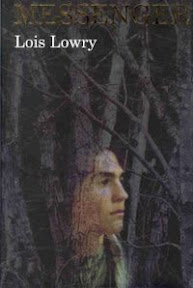
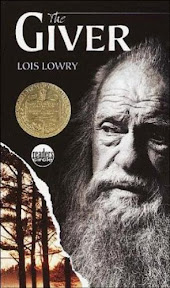
The Giver and Messenger

I really had no plans to pick either of these books up. I knew that Lowry had written a sequel of sorts to a favorite childhood book of mine, The Giver, called Gathering Blue. For the Young Adult Reading Challenge, I picked up Gathering Blue (you can read my review here). Then I found out that Lowry had written a third book, Messenger, which united characters from both books. I decided then and there to reserve both The Giver and Messenger from the library, so that I could have the full experience.

It was a very long time ago that I first read The Giver. The book had just won the Newberry Medal, and I remember very distinctly what an impression this book made on me. If pressed, I would probably categorize The Giver as science fiction, because it is about a utopia, which of course is not quite so perfect as it seems on the surface. The book is deceptively simple. It is written as a children's story, with simple language and uncluttered writing, but rereading it as an adult, I found much more in this profound story than I did as a child.

The Giver's main character is a boy named Jonas, who lives in a perfect society. There is no conflict, poverty, hunger, divorce, injustice, unemployment or inequality. Everyone in the community has their own role; everyone takes pride in their duties. Everyone is safe at all times. As the story opens, Jonas is feeling anxious about the upcoming Ceremony of Twelve where he and the other Elevens are to be given their adult job assignments.

His father explained to Jonas:
..."It's the last of the Ceremonies, as you know. After Twelve, age isn't important. Most of us even lose track of how old we are as time passes, though the information is in the Hall of Open Records, and we could go and look it up if we wanted to. What's important is the preparation for adult life, and the training you'll receive in your Assignment."

Despite the fact they have been observed closely by the Elders in order to select occupations that will match their interests and personalities, Jonas can't figure out what he could possibly be selected for, and the uncertainty bothers him. But at the Ceremony, Jonas is surprised when he is selected for the role of Receiver. He knows that the job is one of great importance to the community, but he is unprepared for what it holds in store for him. He is put in training with an old man he knows only as The Giver. The Giver teaches him that his job is to receive and store all memories of a past before the community and its perfection existed. Exposed to these secrets of his society, Jonas finds that he is terribly burdened and separated from everything and everyone he has ever known.

I think Lowry's genius in this book is in creating characters that the reader genuinely cares about. Jonas never questions the rules of the community until he is given the memories he must receive and learns about both the horrors and the joys that exist outside of his world. Even then, he feels dutiful to his role and makes the decision to sacrifice of himself in order to help others.

The community where Jonas lives is perfectly thought out and detailed. An older reader will suspect right away that things aren't as perfect as they seem in the community (since dystopias after all are a rather popular science fiction topic). Even so the way Lowry shows us first the perfect surface of the society and then gradually exposes us to its flaws is quite elegant.

This book is, of course, also accessible to younger readers as well, since it is designed for them. It might be the first exposure to a science fiction book for a younger reader (I'm pretty sure it was for me) and there is really no better book.

The Giver has become a classic, and deservedly so. If you haven't read it, you have it on my authority that it should be added to your tbr pile asap!

Now on to Messenger. This book picks up from the events at the end of Gathering Blue, but switches narrators. Kira, the main character of Gathering Blue, was learning to find her place as a disabled person in a society that discarded those with imperfections. Matty was Kira's scrappy, mischievous friend, and at the end of the book, he made the decision to leave the place where he and Kira lived, finding his way instead to a different Village where outsiders were welcomed, the helpless and injured are cared for, and everyone lives in harmony. He lives with Kira's father, a blind man called the Seer. His job in the village has been to deliver messages, a role he relishes because of the challenge. Delivering messages frequently takes him through the old Forest. Matty has never had trouble from the Forest, but unwary travelers have been stranded, hurt, and even killed by the Forest.

There is a growing unrest in the Village, though, and Matty must take on his most challenging journey yet. Some of the Villagers have grown tired of taking in new refugees and the borders of the Village are being closed. Before then, Matty must return to his home village and try to convince Kira to return back with him before it is too late.

After recommending both The Giver and Gathering Blue as must-reads, I wish I could say the same for Messenger. It isn't a terrible book, but it just isn't as good as the other two. The Giver and Gathering Blue are connected by the faintest strand, and I'm sure that over the years more than one reader, and perhaps publisher has begged Lowry to connect the two books more concretely. The resulting book feels a bit half-hearted. The characters are there, but the subtle magic that made the previous two books great is just not there. At the end of this book, I had more of a so-what? reaction. If you have read the other two books and liked them, you might want to read this one just to see what happens. Otherwise, as a stand-alone novel, it doesn't hold up.